Mining Help
What is (clean) suffix in QuickMiner?
Short answer: You cannot do anything about it and it is completely normal. Sometimes there will be more, sometimes there will be less of these jobs.
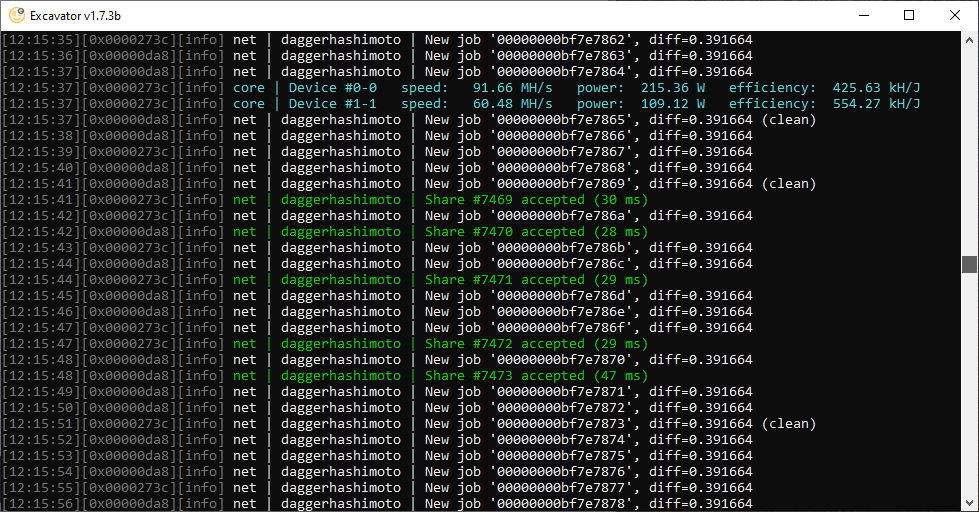
When the job has a “clean" suffix, it means that miner needs to drop the current job immediately and start working on the new job - all previous work is not valid anymore and would result in a rejected share (job not found - stale share). One of the miner qualities is defined by the amount of how much time it takes for it to drop the current job and start working on the new one. The time in between receiving a new clean job and start working on the new job is wasted as these found shares always result in rejection as stale shares. This quality is not visible by the reported hashing speed but rather as a calculated speed on the server-side (NiceHash - accepted speed -> your actual profitability) or rather amount of stale shares (also your high latency to server increase amount of stale shares). Excavator has this switching time in between 1-3 milliseconds on modern CPUs of the latest generation (Intel 10th gen, AMD Ryzen, Threadripper). It can be also observed and calculated from logs (when full detailed logging with -f 0 is enabled). This task is not so simple to optimize, because NVIDIA kernel launches are non-preemptive, which means, once the kernel is started, it cannot be terminated.
When the job is not "clean" it means that the miner does not have to drop a current job, because the previous job is still valid. Therefore when you see a job that isn't "clean" you know that it won't reduce your miner speed consequently. Excavator is made to simply ignore non-clean jobs (these only get printed out, but that's all).
You want to get only jobs that are not clean because then your miner does not have to be interrupted and you get higher performance. You do not have any control over that - NiceHash servers are sending jobs and these depend on buyers of hash power.