Winter Storms vs. Bitcoin Mining Uptime: Zero Downtime is Possible
Winter storms are cutting US hashrate. Here is how to keep uptime.
It is happening again. Extreme cold weather and winter storms are moving across the United States. As residential heating demand spikes, power grids are forcing curtailment on industrial loads. For Bitcoin mining, this means one thing: machines are turning off.
When you look at the global hashrate charts, you can see the dip. But while the weather is force majeure, your mining output does not have to stop.
Uptime is not optional for big players
If you are a home miner, a few days of downtime is annoying. But for institutional miners, public companies, and large farms, downtime is a breach of promise. You have obligations to shareholders and strict uptime targets to meet. "Bad weather" is not something investors like to hear when quarterly reports come out.
This is where the spot market for hashrate changes the game. You do not need physical machines running to produce hashrate. You can buy it.
On NiceHash, we have sufficient liquidity to cover massive outages. Buyers can acquire up to 15 EH/s almost instantly and redirect it to their own pool accounts. We proved this capability in a recent case study with the 256 Foundation. We deployed 1 EH/s (the equivalent of 5,000 S21 Antminers) in mere seconds.
Hosting providers can use this as insurance
There is another use case we are seeing more often: "Hashrate Insurance" for hosting facilities.
When a hosting site goes dark due to a grid failure, clients get frustrated. They lose revenue, and they lose trust in the facility. Smart providers are now using NiceHash to patch these holes. If the site goes down, the provider can immediately bid for hashrate on our marketplace and point it directly to their client’s stratum.
The client sees their workers are active and earning. The user experience is saved. It is a cost of doing business that prevents churn.
You can read a case study we did with Cyberian mine - Zero Downtime is Possible.
What happens to the price?
This situation creates a specific supply and demand dynamic. When US miners turn off, two things happen:
- Global difficulty adjusts (eventually).
- Demand for on-demand hashrate spikes immediately as operators scramble to replace lost uptime.
Because buyers are competing to secure hashrate quickly, they bid higher. We see the price of hashrate on our secondary marketplace detach from the standard Bitcoin FPPS price index. It grows.
This is where the opportunity lies for miners who are not affected by the storms.
Data from 2025: Sellers earn the premium
If your machines are online right now, you should be selling your hashrate on NiceHash rather than mining directly to a pool. The buyers are paying a premium to outbid each other, and that extra money goes to the seller.
Looking at our Annual Bitcoin Mining Report for 2025, the data is clear regarding these events:
- Throughout the year, sellers on NiceHash earned an average 0.13% premium over the FPPS index.
- But during high-demand stress events, this premium explodes. For example, on February 25th, 2025, pay rates spiked to 30.88% above the FPPS benchmark.
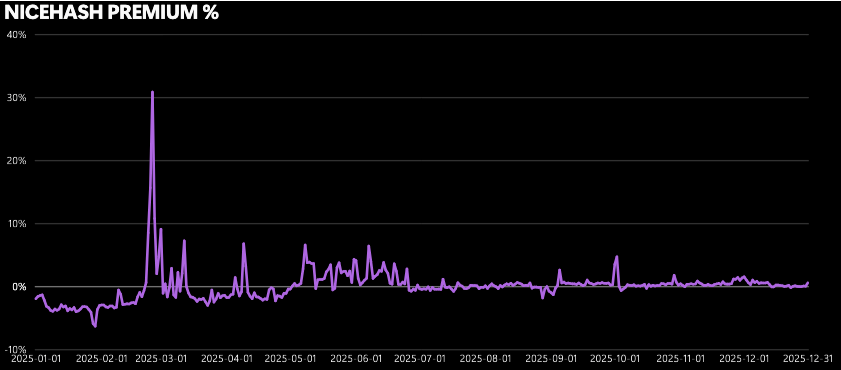
The market is currently reacting to the weather. The demand is there. If you are a buyer, the hashrate is ready to deploy so you don't miss your targets. If you are a seller, connect your machines now to catch the wave of higher pay rates.