Will Litecoin’s 2023 Halving Further Boost its Outperformance of Bitcoin?
In less than 8 months, in August 2023, Litecoin (LTC) will undergo its third halving event. This will cut the inflow of new LTC by half. Litecoin’s inflation rate will then be decreased, theoretically making each LTC more valuable.
This places Litecoin ahead of the halving anticipation, as Bitcoin will undergo its halving over half a year later. Since November, Litecoin has outperformed Bitcoin +33%. Does Litecoin have what it takes to continue this trend? Will Litecoin’s upcoming halving strengthen this movement?
Let’s dive into the factors that would favorably contribute to Litecoin's continued performance when measured against Bitcoin.
Litecoin vs. Bitcoin: Value Proposition
While Bitcoin is often referred to as digital gold, Litecoin is known as something akin to digital silver. Both precious metals are rare but gold is much rarer than silver. Bitcoin and Litecoin mimic this rarity differential by 4x, with Bitcoin’s max supply capped at 21 million vs. 84 million for Litecoin.
Nearing the end of 2022, there is 86% of LTC’s max supply in circulation while Bitcoin is at 92%. As its name implies, former Google engineer Charlie Lee designed Litecoin two years after Bitcoin as a more performant digital asset with an emphasis on transaction speed:
- 54 transactions per second vs. Bitcoin’s 7 tps
- 2.5 minute average block time vs. Bitcoin’s 10.4 min
In terms of comparing the layer-1 functionality of Bitcoin and Litecoin then, this puts Litecoin in an inherently favorable position to serve as a large payments network, demonstrated by comparative transfer fees.
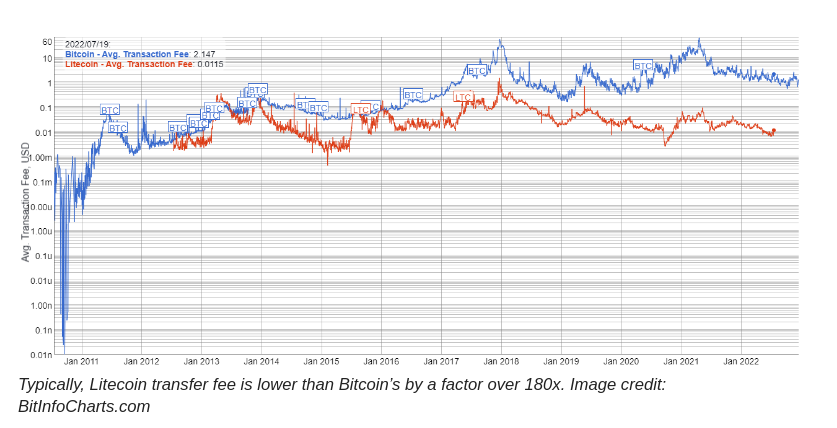
In turn, Bitcoin has to rely on layer-2 networks, such as Lightning Network (LN), to achieve its frictionless money transfer potential and global scaling. Although LN has increased its node count by +130% from 2021 to 2022, it is still unclear if the scaling network will receive the mass adoption that some perceive Bitcoin to receive through its layer-2 LN.
How Are Both Networks Secured?
Litecoin uses a lightweight mining algorithm, a modified Skrypt in contrast to Bitcoin’s energy-intensive SHA-256. As a result, Bitcoin is the world’s most secure network. Malicious actors would have to counter its 227 EH/s (1 exahash =1 quintillion) hashrate computing power, which is virtually unfeasible.
In contrast, Litecoin is secured with 578 TH/s (1 terahash = 1 trillion) hashrate. This is nearly 400,000x lower than Bitcoin’s hashrate. For further comparison, when Ethereum ditched miners for validators in September 2022, its network hashrate was nearly double that of Litecoin at ~1,000 TH/s.
It also appears that Ethereum’s Merge resulted in some ETH miners applying their rigs for Litecoin mining. Since September 15th, Litecoin network’s hashrate has increased by +22%.
Is Litecoin as Decentralized as Bitcoin?
Bitcoin’s network is not only secured with massive computing power, but it is also the most distributed network across 15k nodes. For comparison, Litecoin’s network relies on just 1k nodes, mainly concentrated in the US at 28%.
With that said, this is not the only decentralization measure. After all, the pseudonymous Satoshi Nakamoto’s wallet holds about 1 million BTC across 22,000 wallet addresses, according to River Financial. This is ~5% of all BTC ever mined.
Although these addresses have remained dormant even during the bull run of 2021, it is still a major price suppression risk, as massive supply influx would very likely overshadow BTC demand. How does such an unknown quantity risk compare with Litecoin?
At the end of 2017, Litecoin founder Charlie Lee sold all of his LTC holdings. This was at a time when Litecoin reached its all-time-high of $359. Since then, Litecoin vs. Bitcoin wealth distribution looks like this:
- 87% of Litecoin addresses hold 0-1 LTC.
- 97.7% of Bitcoin addresses hold 0-1 BTC.
- 45.6% of Litecoin’s total wealth is in addresses holding between 100,000 - 10,000,000 LTC.
- 15.5% of Bitcoin’s total wealth is in addresses holding between 10,000 - 1,000,000 BTC.
Therefore, it is safe to say that Litecoin has a much greater whale concentration, which could translate into sporadic selling pressure. Of course, this could also work in Litecoin’s favor, depending on the whales’ disposition. When accounting for all of these factors that largely favor Bitcoin, why did Litecoin end up outperforming Bitcoin this year?
Litecoin Surges Ahead of Bitcoin
Year-to-date, Litecoin outperformed Bitcoin by +9%. This outpacing happened since the end of October, where we see performance divergence by +33%.

The LTC rise coincided with the aforementioned Ethereum miner exodus, having increased Litecoin network’s hashrate. Likewise, as we approach 2023, crypto regulation is on the horizon. It is now feasible to conceive that Litecoin could be one of very few cryptocurrencies treated as a commodity, given no discernible entities involved with Litecoin after Charlie Lee’s divestment.
Further, Litecoin still relies on a proof-of-work consensus, which could further aid in providing it commodity treatment. Case in point, when Ethereum transitioned from proof-of-work to proof-of-stake, Gary Gensler, the SEC Chair, reminded crypto investors that all proof-of-stake cryptocurrencies could be deemed securities.
That’s because “staking” is much like receiving company dividends under the Howey test, as reported by the Wall Street Journal.
“That’s another indicia that under the Howey test, the investing public is anticipating profits based on the efforts of others,”
As a commodity, this pushes Litecoin ahead of over 20,000 altcoins. Moreover, Litecoin has 63x lower energy footprint per transaction compared to Bitcoin, at 18.52 kWh vs. 1,173 kWh respectively. Given governments’ penchant for “going green” and ESG investment framework, Litecoin’s network is then less likely to come under negative scrutiny compared to Bitcoin.
Litecoin’s Accessibility Boosted by Stock Trading Apps
Combined with these positive factors, there is no shortage of Litecoin integration across major platforms, including regulated apps used for stock trading. From well-known, reputable stock brokerages such as Robinhood and TD Ameritrade, Litecoin is available to trade—which only increases the accessibility to Litecoin.
In turn, the obstacles in boosting the potential user base of Litecoin continue to decrease. As stock trading becomes more popular among retail investors through easy-to-use mobile apps that facilitate trading stocks, further exposure to Litecoin in front of new audiences is only poised to positively impact the digital asset.
Litecoin Halving as the Final Push
In the aftermath of the FTX fallout, crypto investors have been looking for safer gains with many traders and investors being particularly cautious. While not as decentralized as Bitcoin, Litecoin has a limited total supply, lower energy footprint, and better tps performance than Bitcoin.
Moreover, Litecoin has largely been out of media coverage. Since 2011, Litecoin has appreciated by over +2,000%. Just like Bitcoin, Litecoin has a halving mechanism to mitigate the supply in order to stabilize the price, serving as an inflationary-controlling force.
Litecoin’s last halving happened on August 5th, 2019, when Litecoin miners’ block reward was cut from 25 to 12.5 LTC. The next halving will then cut 12.5 to 6.25 LTC, which is the exact same block reward Bitcoin miners receive now.
In other words, the rate at which new LTC enter its circulating supply is cut in half at each halving.
With a decreased inflation rate, the rate of supply is reduced against demand. Accordingly, such a disinflationary effect appreciated LTC during the last halving. However, this only happened in anticipation of the Litecoin halving event, having reached the year’s top on June 20th, 2019, at $136.
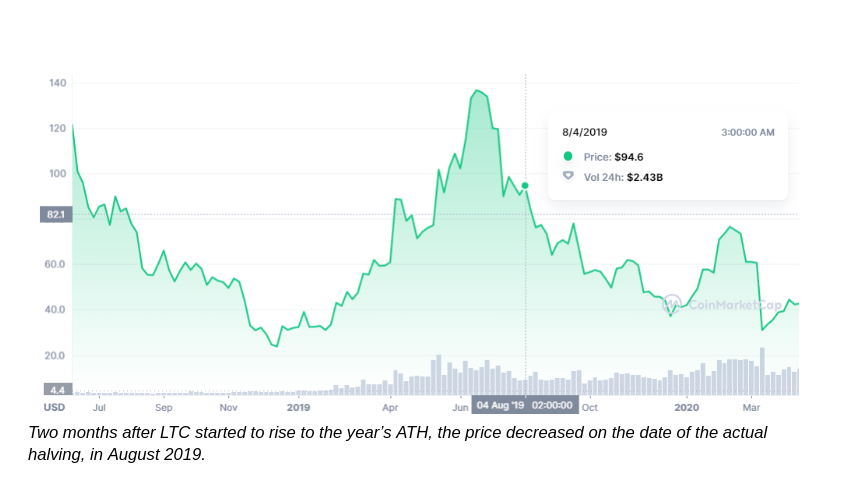
Considering that the crypto market is now much larger, and LTC circulating supply is inching toward 90%, we are now seeing an earlier halving buildup helped by aforementioned factors. Nonetheless, as LTC halving is still far away, on August 23rd, 2023, and in a much harsher macroeconomic environment, we will likely see more valleys and peaks ahead.