Not all payrates are equal: What every Bitcoin miner needs to know
If you're a Bitcoin miner, your profit is determined by one thing: your payrate. But not all payrates are created equal.
Understanding the difference between a standard "Hashprice Index," a "FPPS" pool payrate, and the NiceHash Payrate is the key to maximizing your earnings. Here’s a simple breakdown.
1. What is "Hashprice" or a "Hashprice Index"?
Think of "hashprice" as the market value of your mining hardware's work. It's the standard industry metric for how much a miner can expect to earn for a specific amount of hashrate over a set period.
- What it measures: Expected revenue (in BTC or USD) per unit of hashrate (e.g., Terahash or Petahash) per day.
- Example: A hashprice of $0.05/TH/day means a 100 TH/s miner would expect to earn $5.00 per day.
- How it's calculated: The hashprice index is a theoretical value calculated from the Bitcoin network's fundamentals:
- Block Reward: The fixed subsidy (currently 3.125 BTC).
- Transaction Fees: The average transaction fees collected in recent blocks.
- Network Difficulty: How hard it is to find a block.
- BTC Price: To get a dollar value.
A Hashprice Index is simply a chart that tracks this value over time, giving miners a benchmark for the overall profitability of mining.
2. What is an FPPS (Full Pay-Per-Share) Payrate?
FPPS is a popular payout model used by traditional mining pools. It's designed to give miners a stable, predictable income.
- How it works: The pool promises to pay you a fixed rate for every valid "share" of work your miner submits, regardless of whether the pool actually finds a block or not.
- How the rate is set: This fixed rate is based directly on the Hashprice Index. The pool looks at the average block reward and average transaction fees and calculates a stable, predictable payrate (e.g., 0.000003 BTC per share).
- The Catch (The "FPPS Compromise"):
- No Upside: You get paid the average. If the network suddenly has a spike in transaction fees (making mining temporarily more profitable), you don't see that extra profit. The pool keeps it.
- Pool Risk: The pool takes on all the risk of "luck." If they have a bad day and find no blocks, they still have to pay you. To cover this risk and turn a profit, they charge a pool fee and must be conservative with their payrate.
In short, FPPS gives you stability by sacrificing potential upside. Your payrate is a calculated average, not a real-time price.
3. How the NiceHash Payrate is Different (and More Profitable)
This is the most important part: NiceHash is not a mining pool. It is a hashrate marketplace - with identical user experience as a mining pool.
This fundamental difference changes how your payrate is determined.
- You are a Seller: As a miner, you aren't "joining a pool." You are a seller connecting to a live marketplace to sell your hashrate (your commodity) to the highest bidder.
- Buyers are Competing: On the other side, you have "buyers" who place orders to purchase hashrate. These buyers compete against each other in real-time, bidding up the price.
- The Payrate is a Real-Time "Spot Price": The NiceHash payrate isn't a calculated average like FPPS. It is the real-time spot price for hashrate, determined by demand from human buyers. NiceHash uses a model called RTPPS (Real-Time-Pay-Per-Share), where you are paid for every share at the current market price set by the buyers.
Why NiceHash Marketplace Model Pays More Than FPPS?
Here’s why it happens:
- Buyers Will Pay a Premium: Why would a buyer pay more than the standard FPPS rate?
- Solo Miners: A buyer might be solo mining, hoping to find a full block. They are willing to pay a premium (e.g., 5-10% above FPPS) for a massive amount of hashrate for a short time to increase their probability of confirming a block.
- Arbitrage & Spikes: Smart buyers know when transaction fees are spiking. They will quickly bid up the price on NiceHash to buy hashrate and point it at a pool, capturing the profit from the fee spike. A profit you would miss on an FPPS pool.
- Convenience: Large buyers pay for the convenience of getting massive hashrate on-demand without owning any hardware.
- You Capture the Upside: Because buyers are competing and paying a premium, you (the seller) capture that premium. When demand for hashrate is high, the price you are paid for your hashpower goes up instantly. On an FPPS pool, it doesn't.
Important Note: All sellers on NiceHash are paid the exact same rate for each hash they contribute to the market. This rate is the volume-weighted average payrate across all currently active buy orders, ensuring a fair, unified price for the sold hashrate.
- The Price Floor Effect: Minimal Downside Risk
One major advantage of NiceHash compared to other open markets is its built-in protection against price drops. While the marketplace allows for premium payrates driven by buyer competition, it also maintains a strong safety net that keeps rates from falling below standard pool levels..
- The Arbitrage Floor: When the NiceHash payrate approaches or falls below the standard Hashprice Index, arbitrage buyers step in. These buyers instantly purchase the cheaper hashrate and redirect it to FPPS pools, capturing small but consistent profits. This activity creates continuous, organic demand that holds the market up.
- Result: Naturally Stable, With Room for Upside: This natural demand floor keeps NiceHash payrates from staying below FPPS levels for long. The result is a self-balancing market where miners capture the upside from buyer competition, without suffering the deep dips seen in typical open markets.
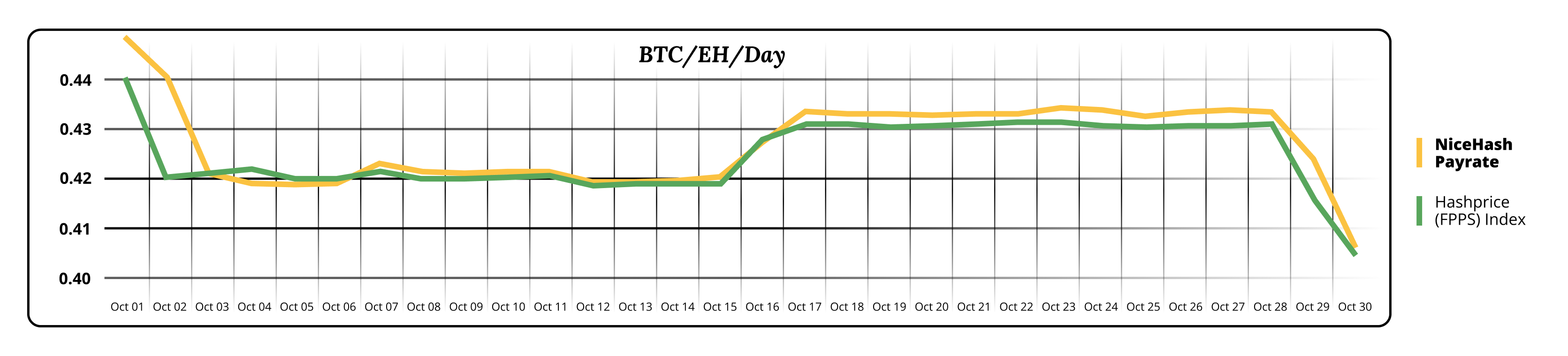
Data shows that NiceHash payrates outperform FPPS pools far more often than they fall behind.
| Date | NiceHash Payrate | Hashprice (FPPS) Index | NiceHash Premium (%) |
|---|---|---|---|
| 2025-10-30 | 0.40710873 | 0.40561996 | 0.37% |
| 2025-10-29 | 0.42399628 | 0.41647693 | 1.81% |
| 2025-10-28 | 0.43278074 | 0.43102676 | 0.41% |
| 2025-10-27 | 0.43292086 | 0.43069564 | 0.52% |
| 2025-10-26 | 0.43261928 | 0.43039451 | 0.52% |
| 2025-10-25 | 0.43177419 | 0.43045851 | 0.31% |
| 2025-10-24 | 0.43289332 | 0.43085284 | 0.47% |
| 2025-10-23 | 0.43335697 | 0.43119091 | 0.50% |
| 2025-10-22 | 0.43193012 | 0.43114606 | 0.18% |
| 2025-10-21 | 0.43192665 | 0.43102634 | 0.21% |
| 2025-10-20 | 0.43139686 | 0.43085994 | 0.12% |
| 2025-10-19 | 0.43159326 | 0.43050858 | 0.25% |
| 2025-10-18 | 0.43182363 | 0.43142703 | 0.09% |
| 2025-10-17 | 0.43280719 | 0.43139583 | 0.33% |
| 2025-10-16 | 0.42722964 | 0.42833194 | -0.26% |
| 2025-10-15 | 0.42067405 | 0.41907229 | 0.38% |
| 2025-10-14 | 0.41995055 | 0.41905847 | 0.21% |
| 2025-10-13 | 0.41969864 | 0.41922596 | 0.11% |
| 2025-10-12 | 0.41967421 | 0.41902076 | 0.16% |
| 2025-10-11 | 0.42161792 | 0.42119558 | 0.10% |
| 2025-10-10 | 0.42182007 | 0.42052489 | 0.31% |
| 2025-10-09 | 0.42113919 | 0.42036318 | 0.18% |
| 2025-10-08 | 0.42104243 | 0.42002848 | 0.24% |
| 2025-10-07 | 0.42303375 | 0.42164330 | 0.33% |
| 2025-10-06 | 0.41904189 | 0.41945518 | -0.10% |
| 2025-10-05 | 0.41825708 | 0.41977982 | -0.36% |
| 2025-10-04 | 0.41996036 | 0.42254232 | -0.61% |
| 2025-10-03 | 0.42170118 | 0.42123938 | 0.11% |
| 2025-10-02 | 0.44036961 | 0.42034319 | 4.76% |
| 2025-10-01 | 0.45601048 | 0.44033870 | 3.56% |
The "Premium (%)" column is real-world proof of this marketplace dynamic at work. It's the extra amount that buyers are willing to pay for your hashrate above the standard, calculated FPPS-based hashprice. It's how much more miners get paid on NiceHash vs. FPPS pools.
Above data is acquired from NiceHash SHA256AsicBoost payrate and Luxor Hashprice Index.
Summary: NiceHash vs. FPPS
| Feature | FPPS (Traditional Pool) | NiceHash (Hashpower Marketplace) |
|---|---|---|
| Payrate Basis | Calculated Average: Fixed rate set by blockchain data (hashprice/difficulty). | Real-Time Price: Determined by live demand and price willingness from human buyers. |
| Model | You are a participant in a pool. | You are a seller in a competitive market. |
| Upside | None. You get the stable, average rate. | Full Upside. You get paid the premium set by buyer competition. |
| Downside Risk | Low (due to fixed rate). | Extremely Low (protected by arbitrage buyers creating a high-volume "watermark" floor). |
| Payout System | FPPS (Full Pay-Per-Share) | RTPPS (Real-Time-Pay-Per-Share) |
| Result | A predictable, stable payrate that often trails the true market value. | A dynamic payrate that consistently reflects the highest price someone is willing to pay. |
The bottom line: By connecting to NiceHash, you are no longer a simple miner accepting an average rate. You are a supplier selling your hashpower in a competitive spot market, allowing you to capture a premium that FPPS miners never see, while still being protected against price dips.