The history of cryptocurrency mining
I have decided to write this piece of article for all the GPU miners that are afraid of Ethereum going to Proof-of-Stake and thus making mining unprofitable. Many new miners are not aware that mining was profitable even before Ethereum launched in 2015, and will most likely be profitable after Ethereum moves from the Proof-of-Work consensus.
The beginnings of GPU mining
When Bitcoin launched in 2009 the first mining was done by CPUs. Satoshi’s idea of “one CPU - one vote” was very realistic as there were only CPU miners (software) available at the time.
The first miner was the official Bitcoin miner. You can access it here. Note that Bitcoin Core is the first and official Bitcoin miner which uses CPU to mine. It is practically worthless to mine with Bitcoin Core at present time.
Not long after, the first GPU miner was developed, which allowed users to achieve higher speeds with GPUs. Soon after, CPU mining was not profitable anymore because GPU miners took over.
It is believed that the first GPU miner was developed by ArtForz, who allegedly mined the first block with his GPU farm on 18th of July, 2010. The first publicly available GPU mining software was released by BitcoinTalk member Puddinpop. You can find the post here.
In 2012, the first ASIC projects started to emerge. Not long after, Bitcoin blockchain was taken over by ASIC miners and GPU mining became obsolete and ineffective.
Altcoin GPU mining
In 2011, Litecoin was launched.
It featured a new algorithm called Scrypt. This happened before SHA256 (Bitcoin) ASICs took over the Bitcoin network. Soon after the Bitcoin difficulty increased all the GPU miners were able to move to another project and continue to mine profitably.
In 2013, the famous Dogecoin was launched.
Doge also uses the Scrypt algorithm for its PoW consensus. Doge was also mined with GPUs and offered a better profitability for some time.
In 2014, ZeusMiner was released.
The first Scrypt ASIC miner. This ended the Scrypt GPU mining era. GPU miners, again, had no profitable coin to mine.
In 2014, Monero was launched.
Monero used the Cryptonight algorithm back in the day. Miners were able to use CPU and GPU for mining. The Monero community is also against ASIC miners. Monero was forked 3 times in the past and currently uses the RandomX algorithm to fight off ASICs.
In 2014, Vertcoin was launched.
Vertcoin was one of the first cryptocurrency projects that was developed with the intention to be ASIC-resistant. GPU miners were able to mine profitably for a brief period of time again.
In 2015, Ethereum was launched.
Ethereum was also going strong against ASIC miners as they posed a threat to decentralization. Ethereum uses Ethash (modified DaggerHashimoto) algorithm. With Ethereum price rising over the first year of existence, the mining profitability rose again. The rest is history.
Summary
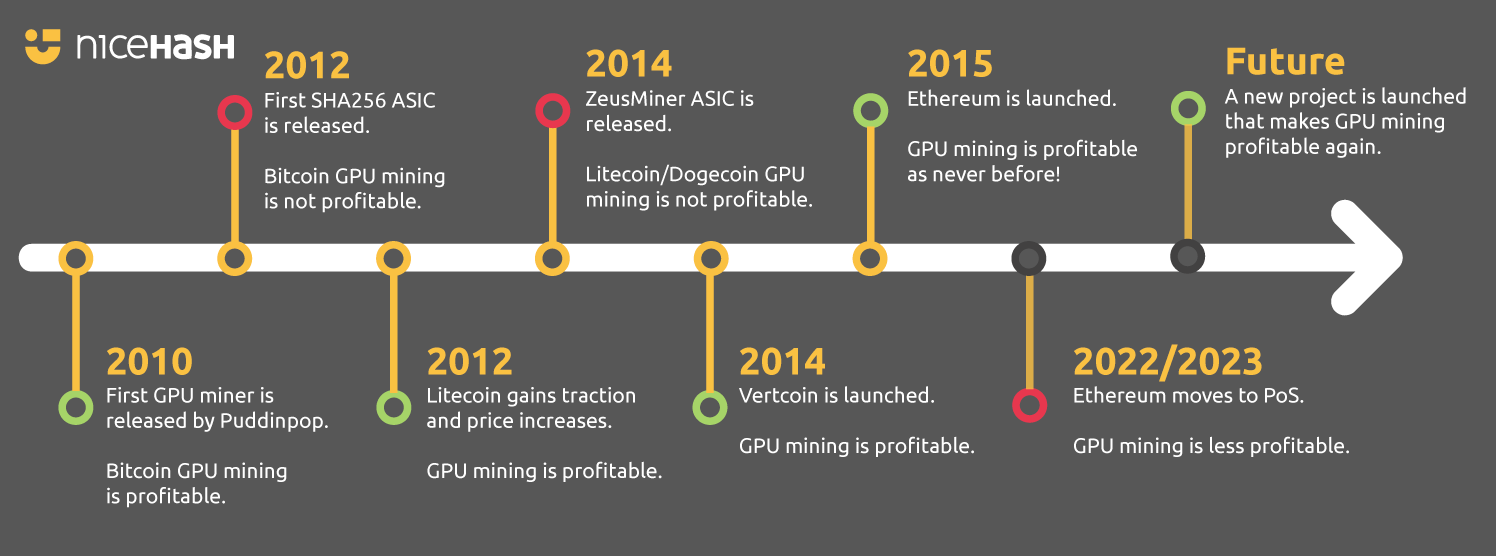
As seen above, there were periods of lull between the times when one coin was unprofitable to mine and a new project was launched.
If there is something we can learn from the relatively short crypto mining history is that the GPU mining will always be. Even if there is a period of less profitable mining or even a couple of unprofitable months, that does not mean that the GPU mining has died. Sooner or later a new project will emerge that will allow miners to mine profitably again.