Should you keep your money in Bitcoin or in a Bank?
With the recent failure of the Silicon Valley Bank and other major banks, many are left wondering if their funds are really that much safer in a bank than Bitcoin. In this article, we will explore some of the benefits that Bitcoin has over traditional banking.

Why was Bitcoin created in the first place?
The first Bitcoin block was mined on the 3rd of January 2009, amidst the global financial crisis. In this genesis block, Satoshi Nakamoto wrote: “The Times 03/Jan/2009 Chancellor on brink of second bailout for banks.”.
At the time, some had seen their money and pensions gone from their accounts, and Bitcoin was meant to be the beginning of the end for the heavy reliance on banks. The cryptocurrency serves as a better alternative to hiding cash under your mattress, while implementing superior functionalities for transacting value.
Is it safer to have your money in Bitcoin or in a Bank?
Depending on the country you live in, when you deposit your money in a bank, it might be insured up to a certain amount per depositor. However, if you exceed this amount and your bank collapses, you most likely will never be able to recover the excess funds.
This was a really big problem with the collapse of SVB, since by the end of last year, over 96% of the deposits were actually not insured by the FDIC. This is because the FDIC only insures deposits up to 250,000 USD per depositor, and the funds held by tech giants in SVB far exceed this amount.
The chart you see below is not from a meme coin or a project that just rug pulled its users. It's from the 16th largest bank in the United States!
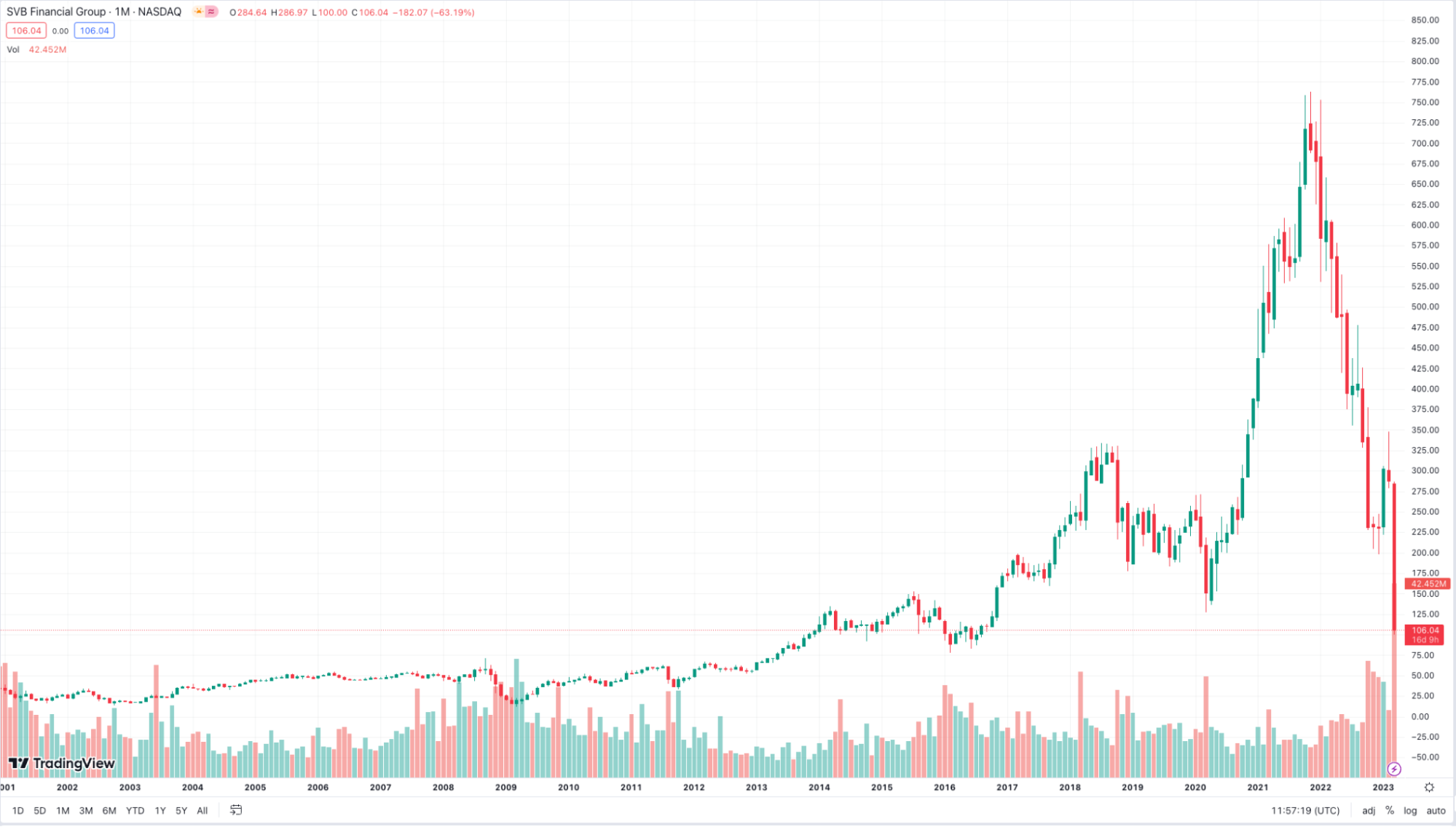
Earlier this month, we published an article about the pros and cons of custodial and non-custodial wallets. You can think of banks as custodial wallets. In the end, you do not own your own money, transactions may take several days to complete, and if you want to cash out more than a few thousands of dollars, the bank may not even have the cash immediately available to you.
If you don’t have a large net worth and you want peace of mind, there is not much wrong with keeping your funds in a bank, as long as they are insured. If you surpass the cap, perhaps splitting your money on various banks might be a good option. However, if you have a large net worth, run a multi-million dollar corporation or simply want to make sure that you have access to your money, using Bitcoin as a store of value might be something to consider.
Bitcoin allows you to control your own money - to be your own bank. While ensuring that your BTC wallets are secure might not be trivial, it’s not an insurmountable task. Keeping your BTC in cold storage could arguably be a safer option than depositing them in a bank while uninsured.
This way, you are not relying on any third party and can still access your funds at any time. Even for those who may not have millions, this last point is quite important. We have seen time and time again that governments or banks may halt or limit cash withdrawals, for example in Greece in 2015, or in Nigeria today.
Having access to your money is key in any economy, and trusting no one other than yourself is usually your best option. Banks and governments are not reliable.
Why is Bitcoin so useful for organizations and individuals?
For both individuals and large corporations, Bitcoin is a revolutionary technology. It allows anyone to send funds anywhere in the world in a matter of minutes (if not nearly instantaneously with the Lightning Network) and at a very low cost.
Bitcoin improves financial inclusion in developing countries, it facilitates cross-border trade and also lowers transaction costs in transfer of remittances and aid funds together with faster speeds.
Blockchain transactions can save a lot of time and money for companies that employ people from all over the world, or for those who work abroad and send money to their families back home. These people can stop spending fortunes in services like Western Union, and provide more to their relatives in a timely manner.
Moreover, Bitcoin’s total supply is capped at 21 million coins, and its issuance rate is predictable and pre-programmed. This means that no government or entity has the power to alter the rate of issuance or total supply of the currency.
In fiat currencies, governments may print large sums of money and inflate their currency, devaluing it in foreign markets. While in the short term, Bitcoin may be volatile, it is still a deflationary currency. In the long term, you may expect to end up with more purchasing power than you had before.