How Ordinal Inscriptions Could Boost the Adoption of Bitcoin's Lightning Network
Bitcoin is heading for a major confluence hype in 2024. On one hand, the Bitcoin network will undergo 4th halving, which will further reduce Bitcoin inflation rate from the current 1.74%. Boosting this sound money narrative, new institutional capital inflows should almost certainly open with Bitcoin ETF approvals.
Ahead of this favorable narrative fusion, Michael Saylor’s MicroStrategy has already gained over $1 billion in unrealized profits from the latest Bitcoin rally. Zoomed out 15 years after its mainnet launch, Bitcoin has established itself as a revolutionary financial network.
Two drivers pushed the Bitcoin revolution, centered around financial self-custody:
- Sending money globally without asking for permission from third parties, be they governments or banks.
- Storing wealth due to Bitcoin’s maximum coin supply of 21 million BTC. This removes wealth erosion so standardized with fiat money, as central banks can tweak money supply at arbitrary points.
Yet, there is another avenue for Bitcoin adoption in the works. This evolving utility comes from Ordinal Inscriptions. Although Bitcoin’s core code is conservative to preserve its sound money status, extending its smart contracts has opened novel use cases on the Bitcoin blockchain.
Understanding Ordinal Inscriptions
On a granular level, BTC tokens are smart contracts, enforced by a vast computing network that solves cryptographic puzzles to make peer-to-peer money happen. In January 2023, Casey Rodarmor extended Bitcoin’s smart contract utility beyond its core purpose.
Rodarmor accomplished this by adding metadata to satoshis, as Bitcoin’s smallest units. This on-chain metadata can then be viewable as text, images, code or even videos.
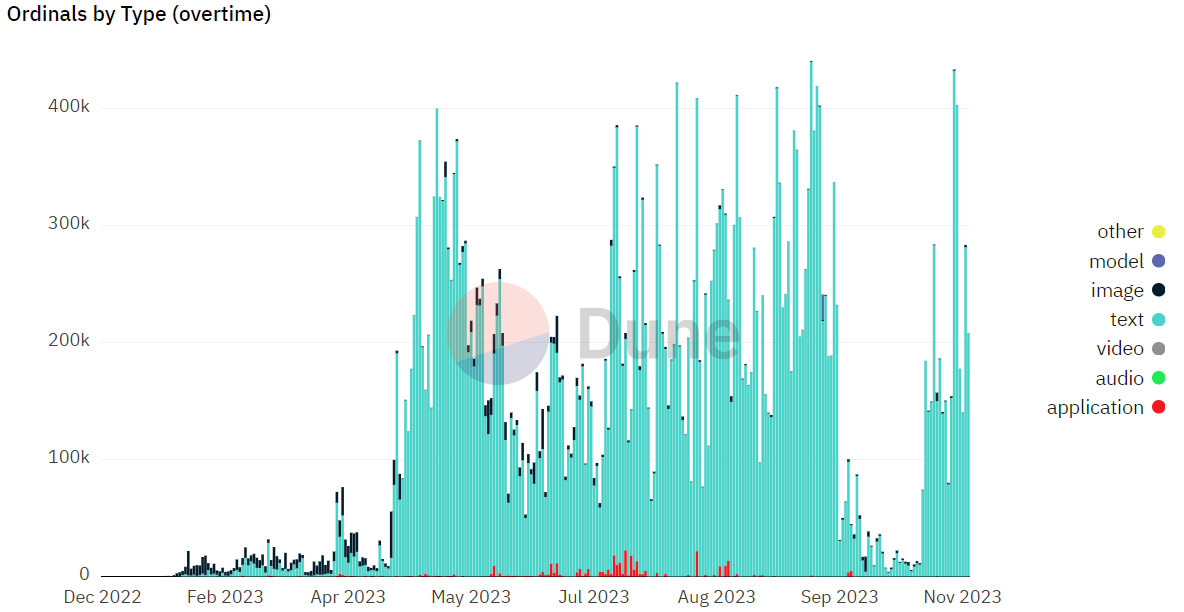 Nearly all Bitcoin Ordinals are text-based. Image courtesy of Dune dashboard via @dgtl_assets
As users inscribe arbitrary data to satoshis, they are assigned in the order in which they are mined/transferred. From this comes the name “ordinal”, mirroring the fact that Ordinals are just as immutable and permanent as bitcoins. This itself is a significant improvement on NFTs. Unlike Bitcoin Ordinals, ERC-20 based NFT tokens largely rely on off-chain retrievals.
In other words, NFTs themselves are not stored on the blockchain, but on either off-chain centralized servers or decentralized storage networks like the InterPlanetary File System (IPFS).
Moreover, Ordinal Inscriptions can be used to either create on-chain NFT-like assets or fungible BRC-20 tokens. The latter are still experimental as JSON inscriptions on satoshis. Nonetheless, just like ERC-20 token minting expands Ethereum use cases, BRC-20 standard could evolve beyond its current raw form.
Unfortunately, there is one big obstacle to Ordinal Inscriptions as Bitcoin’s third adoption avenue - scalability.
Ordinals as Bitcoin Network’s Burden
Because they are entirely on-chain, Bitcoin Ordinals increase the network’s load. Each mined data block contains thousands of BTC transactions, up to 4 MB theoretically but rarely exceeding 2 MB. Originally when Bitcoin launched, the block size was limited to 1MB.
This changed in 2017 with the activated Segregated Witness (SegWit) upgrade. Although not increasing block size directly, SegWit made it possible to migrate transactions’ signature data off-chain. Eventually, the aforementioned Bitcoin developer, Casey Rodarmor, used Taproot upgrade (2021) by combining multiple Ordinal Inscriptions into a single transaction.
This Taproot loophole allowed miners to effectively increase the block size to 4MB. However, even if Bitcoin’s block size is to be increased tenfold, this poses a threat to Bitcoin's underlying prospect as a decentralized wealth network. Larger block sizes would require greater computing and storage needs, inevitably leading to centralization.
In the present state, the Bitcoin network can only process 7 transactions per second. This translates to different transaction fees for speed tiers. For example, a high priority tier could require 84 sat/vB ($4.30) vs no priority tier of 16 sat/vB ($0.82), all depending on how long someone is willing to wait for a BTC transfer.
During the Ordinal hype peak in May 2023, as inscriptions added extra data load, this boosted fees to rarely seen highs. It was not uncommon to see a $30 fee per transaction, resulting in a backlog of unconfirmed transactions in the tens of thousands, as miners only took high-payers.
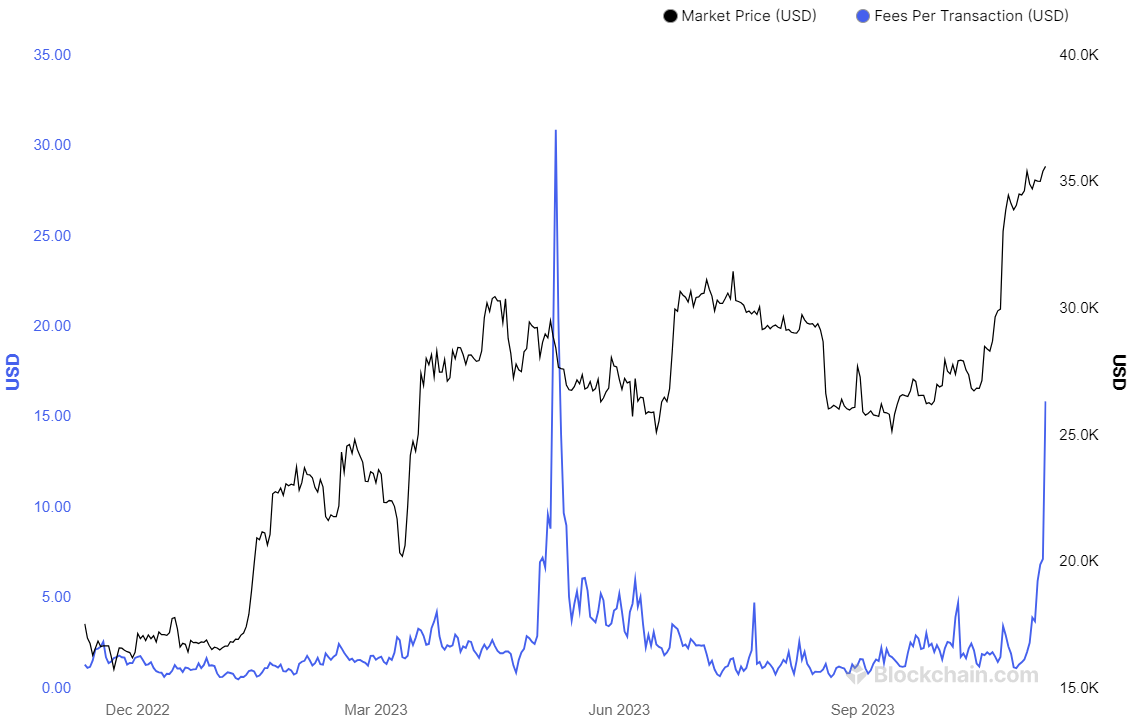 The latest fee spike in November also coincides with increased Ordinal Inscriptions activity. Image courtesy of blockchain.com
In total, people have inscribed 38.8 million Ordinals. Although this made Bitcoin miners very happy, having taken $85.4 million in Ordinal fees, it leaves the Bitcoin network in a precarious position.
After all, if it becomes too expensive to send money, is the extra Ordinal utility worth it? Fortunately, Lightning Network comes to the scalability rescue.
The Lightning Network as a Scalability Solution
Just like Ethereum has its own set of blockchain off-roads, from Polygon to Arbitrum, so does Bitcoin to offload traffic from the Bitcoin mainnet. With Lightning Network as a layer 2 scaling solution, high transaction fees turn into negligible fees at lightning speeds. In fact, the speed is comparable to standard Visa/MasterCard payments but cheaper.
If developers were to increase Bitcoin scaling to increase block sizes, this would be called layer 1 scaling. However, as that would lead to centralization, layer 2 scaling is the next best approach.
Lightning Network accomplishes layer 2 scaling through its own network of payment channels. As long as each channel remains open, by being funded with BTC, payments can be conducted. Only after the channel is closed are all those transactions bundled up into a single transaction and returned to Bitcoin mainnet for confirmation.
This approach makes it possible to have exceedingly low LN fees, near-instant transactions, while still retaining the security and finality of Bitcoin blockchain. Lightning Network has been steadily growing over the years, but it is still heavily underutilized.
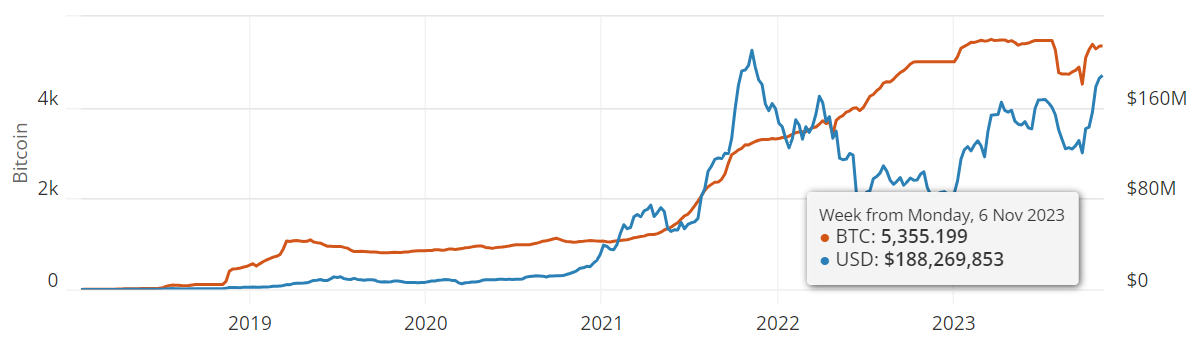 As of November, LN’s cumulative capacity across channels is $188.2 million worth of bitcoins. Image courtesy of bitcoinvisuals.com
For comparison, November saw around $35k worth of confirmed daily BTC transactions. As Bitcoin’s Taproot upgrade in 2021 streamlined transaction processing and adding smart contract utility, LN developers continue to evolve it.
In addition to lightning speed on the cheap, Lightning Network has made big inroads into smart contracts getting smarter.
Of particular note is Lightning Labs’ release of toolkits this July to integrate AI agents like ChatGPT. This building tool allows people to impart BTC onto AI apps, which can then hold, send and receive Bitcoin payments, regardless if on mainnet or on LN channels.
One could see a near future in which LN’s smart contracts could be used for automated service/job payments, advanced trading strategies, escrows or the distribution of royalties for Ordinals.
The Catalyst Effect of Ordinal Inscriptions
So far, Bitcoin has been largely perceived as a store of value. This greatly lessened the network bandwidth needs and kept the transaction fees relatively low. However, Ordinal Inscriptions are poised to upset this status quo.
Even without Ordinals ever popping up, one must consider if Bitcoin is ready for mass adoption. After all, the Ordinals traffic simply showcased what would happen with that kind of uptick. From this standpoint, Ordinals are an accelerating agent.
Merchants who have already integrated LN into their business model benefit massively as BTC gains value. And just as merchant adoption of LN spreads, Ordinals are likely to push regular Bitcoin holders into LN’s scalability arms.
With AI agents interacting with BTC smart contracts in play, another ecosystem is on the horizon. Altogether, these ingredients make for a solid Bitcoin adoption growth, facilitated by Bitcoin’s previous upgrades, novelty Ordinal assets that came out of those upgrades, and the Lightning Network itself to carry new Bitcoin forefronts.