How Bitcoin ETFs Are Bridging Crypto and Traditional Finance
When the Securities and Exchange Commission (SEC) approved eleven Bitcoin ETFs on January 10th, it marked a turning point in financial history. For nearly 15 years, Bitcoin had been the target of a multi-pronged attack, often dubbed as a fad, fraud, wasteful or underground network for illicit activity.
As Bitcoin evangelists weathered the institutional FUD, institutions themselves eventually took advantage of Bitcoin’s open, permissionless nature. Not only did JPMorgan Chase CEO, Jamie Dimon, call crypto-enthusiasts “stupid”, but BlackRock CEO Larry Fink had previously called Bitcoin an “index of money laundering”.
In the post-Bitcoin ETF landscape, the very same Fink regaled the public that BlackRock’s IBIT Bitcoin ETF is “the fastest growing ETF in the history of ETFs”. With Bitcoin’s fourth halving on April 22th, which will again cut BTC inflation rate in half, it is important to understand the implications on the horizon.
The Significance of Bitcoin ETF Approvals
It bears remembering that the SEC fought tooth and nail against spot-traded Bitcoin ETFs. The Winklevoss brothers, of Gemini crypto exchange, filed the first Bitcoin application in 2013. Yet, it took eight years for the futures-traded Bitcoin ETF from ProShares (BITO) to see the light of day.
The difference between futures and spot-traded Bitcoin ETFs is drastic, as only the latter infer investment in actual Bitcoin. As such, futures-traded investment vehicles are subpar “next-best” Bitcoin exposure, to put it generously. The problem is, futures contracts are spread between long-dated and short-dated.
And as long-dated contracts receive higher prices than short-dated ones, these Bitcoin ETFs then have to sell lower-priced contracts set to expire. In turn, they have to buy the pricier ones on a rolling monthly basis. This results in contango, wherein the investors in futures-traded Bitcoin ETFs actually underperform vs the underlying Bitcoin price.
Because of this contango phenomenon, futures-based ETFs have often been described as “fatally flawed”.
More importantly, it gave rise to speculation that this was the exact reason why the SEC approved them in the first place. After all, the SEC had its hand forced after losing the lawsuit against Grayscale, as it tried to convert Bitcoin Trust into a spot ETF.
“Today’s decision is a victory not only for Grayscale, but for everyone who wants to see fair treatment of digital assets under a clear legal framework.”
Chamber of Progress CEO Adam Kovacevich, following the SEC’s legal defeat
Fast forward five months from August 2023, and spot-traded Bitcoin ETFs were born. After this landmark milestone broke down legal walls, the bridge between digital assets and traditional finance will facilitate a new investing landscape.
Mechanics and Impact of Spot Bitcoin ETFs
It is no secret that many bitcoins have been forever lost. Some have estimated that up to 6 million BTC has been irretrievably lost due to lost access to the Bitcoin network. This is important to understand because traditional investors view this potential as intimidating.
While they may share the concerns of Bitcoin maximalists that USD is undergoing constant debasement while USG continues to incur unpayable national debt, the bridge to self-custody BTC is too far. This is where spot-traded Bitcoin ETFs come in.
Without worrying about holding Bitcoin network access, investors can now receive direct BTC price exposure. As with other exchange-traded funds (ETFs), they simply buy shares in a fund that holds Bitcoin. These shares representing Bitcoin are then traded like other stocks, on either the New York Stock Exchange or Nasdaq.
In turn, the funds delegate the custody and trading of BTC to regulated crypto exchanges. Most Bitcoin ETFs have selected Coinbase as having the most robust cloud security, with the exception of Fidelity’s FBTC and VanEck’s HODL. The actual mechanism is well-regulated after many feedback sessions between the SEC and the financial institutions:
- When investors want to reap the BTC price gains, they redeem them through authorized participants (APs).
- APs place the order which has to be approved by the ETF issuer.
- Whether buying or selling ETF shares, market makers-broker dealers (MM-BD) are facilitating the trade.
- On either side of the equation, MM-BDs deliver orders to transfer agents to register and verify transactions.
- Finally, ETF issuers instruct BTC custodians to either release (redeem) or acquire the specified amount of BTC, aligned with the number of representative shares.
Since the rollout of eleven Bitcoin ETFs, weekly inflows into these funds have exceeded all expectations.
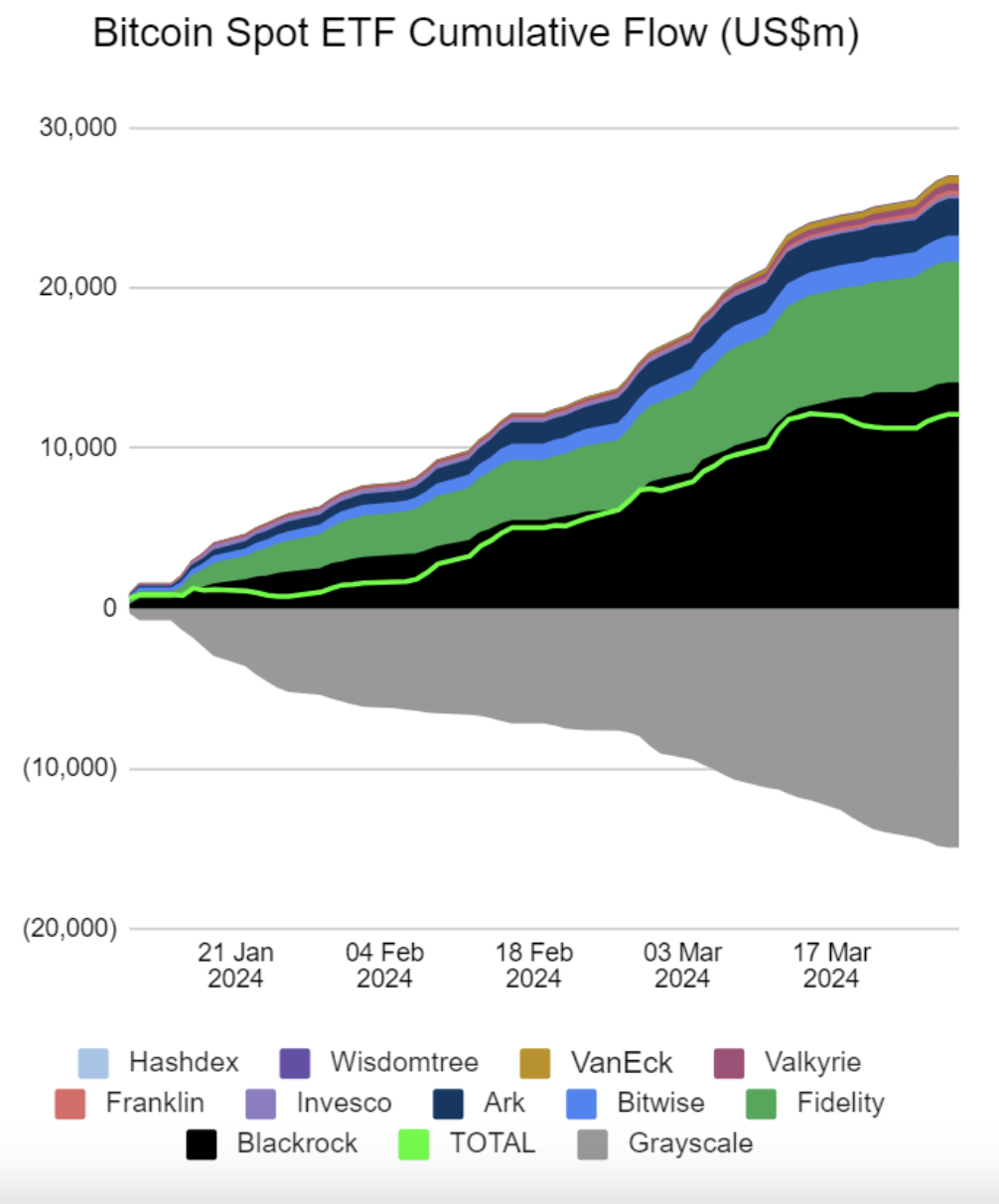 Grayscale (gray below zero) exerted great selling pressure at the benefit of other BTC ETFs. Image credit: Farside Investors
While Grayscale’s GBTC still holds the dominant AuM of $24.33 billion, BlackRock’s IBIT is rapidly catching up with $17.24 billion. In fact, because the difference between their fees is stark, 1.50% vs 0.25% (0.12% fee waiver) respectively, Grayscale served as the primary FUD driver, causing BTC price volatility post-Bitcoin ETF launch.
Yet, even with massive GBTC outflows, the demand for Bitcoin exposure outpaced the selling pressure. As the Bitcoin network received trading signals back and forth, Bitcoin broke its old all-time high price of $69k November 2021 at $73.7k on March 14th 2024.
Indicating further tailwind ahead of the fourth halving, Bitcoin closed March with the highest monthly candle above all previous cycles. When BTC miner reward goes from 6.25 to 3.125 BTC on April 22nd, the new inflow of bitcoins will be cut in half.
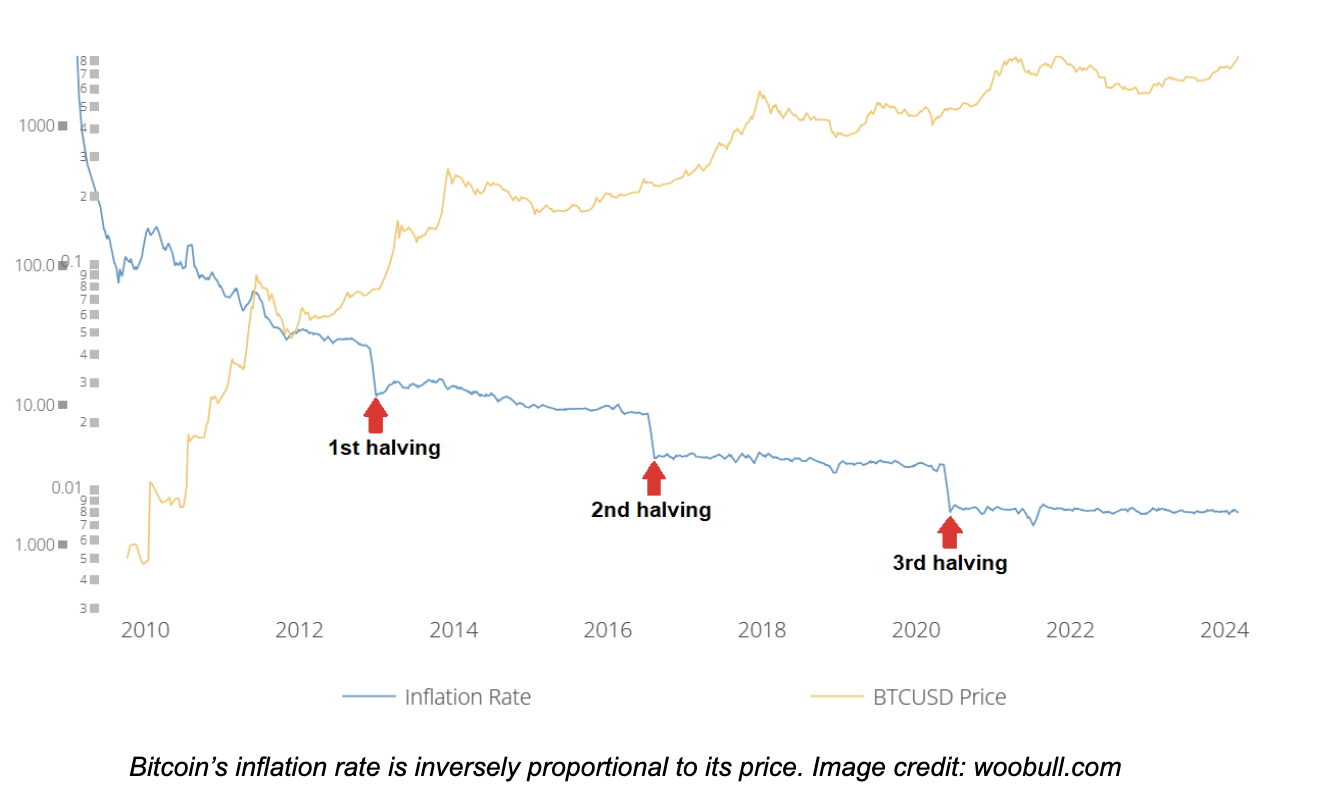
Taking into account the estimated loss of access to 6 million BTC, combined with the fact that 93.67% of all BTC has already been mined, this makes Bitcoin the world's most scarce asset. But unlike gold, it cannot be seized by governments, nor can mining companies find new gold veins.
And unlike gold, Bitcoin is transportable across borders in one’s own mind. These fundamentals themselves are further poised to drive up BTC price ahead of present bullish winds.
Broader Implications for the Financial Ecosystem
Outside of people taking profits from long-term holding, cutting miner rewards in half will serve as another major selling pressure. Mining companies that haven’t upgraded their operations will exit the scene, as it happened with previous accumulation and capitulation cycles.
Luxor Hashrate Index estimated that 3% of Bitcoin miners could leave the network if the BTC price stays within the $66k - $68k range. Yet, against the selling pressure, institutional allocation of Bitcoin is likely to materialize as an offsetting force.
According to the Bitwise/VettaFi 2024 survey of financial advisors, large crypto allocations (over 3%) across a wide range of funds have more than doubled, from 22% of all client portfolios in 2022 to 47% in 2023. Of those surveyed, 11% handled funds above $1 billion AuM.
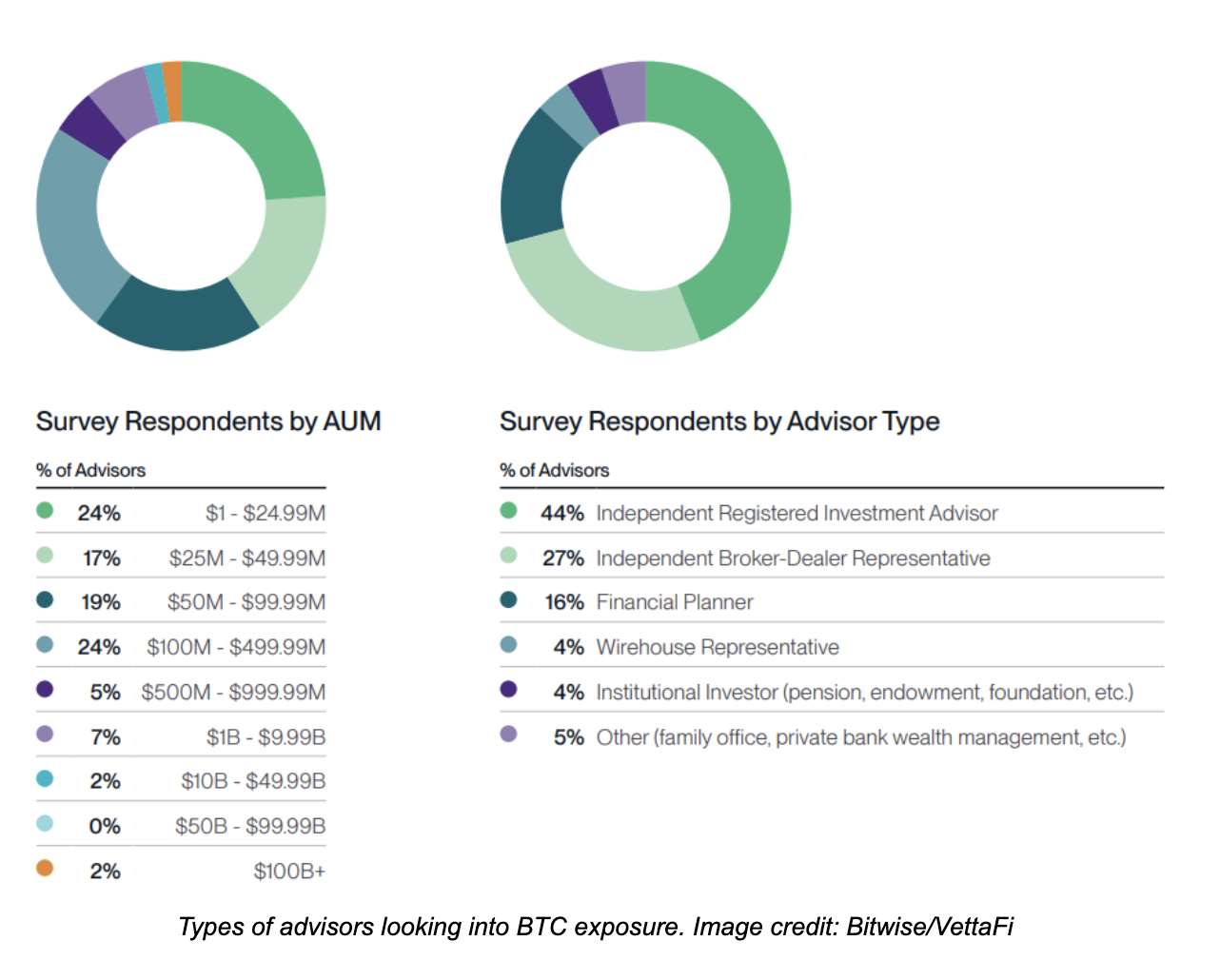
Overall, 64% of respondents view Bitcoin ETFs at the most favorable investment exposure. Their confidence in allocating more BTC into their portfolio is conditioned by better regulation (50%) and the launch of spot-based ETFs (14%).
Over the next five years, 38% of financial advisors view BTC price going above $70k, up to $500k (3%). This doesn’t account for financial advisors recruitment-tracking veteran crypto enthusiasts as the market matures.
And as Bitcoin market liquidity deepens due to these incremental allocations, this will likely spill over into the broader digital asset market. However, unlike Bitcoin’s commodity status, the altcoin market is yet to achieve legitimacy by regulation or legislation.
It remains unclear if the Congress will ever deliver such a comprehensive framework, instead of relying on the SEC’s arbitrary case-by-case deliberations.
Conclusion
For the longest time, accessibility to digital assets has been self-imposed. After much legal struggle, Bitcoin ETFs broke that intimidation barrier and normalized the concept of digital value. Of all the cryptocurrencies, Bitcoin is the best suited to boost confidence in digital value because it is anchored in hardware and computing energy.
After record-breaking inflows into Bitcoin ETFs, both clients and their advisors are now hyped for the future gains stemming from Bitcoin’s scarcity. Bitcoin ETFs are securing their trust with regulated transparency and increased liquidity.
Even the largest US banks want a piece of the Bitcoin exposure pie. With such broad normalization of digital assets on the horizon, the wider crypto market is set for another wave of investments.