Key Takeaways from the 2025 Bitcoin Mining Review
The Bitcoin mining landscape underwent a massive transformation in 2025. Moving away from the "wild west" of early cycles, the industry has matured into a capital-intensive, industrial-scale sector defined by operational discipline and fierce competition for energy.
We are proud to sponsor the 2025 Bitcoin Mining Market Review by Digital Mining Solutions - a comprehensive report that offers a deep dive into the data, trends, and economics shaping our industry. Whether you are a solo miner or an institutional operator, understanding these shifts is critical for navigating the year ahead.
Here is a breakdown of the report's most vital insights, from NiceHash’s market-leading payrates to the tectonic shift toward AI integration.
1. The NiceHash Advantage: Proven Premium Payrates
One of the report’s standout findings for our community is the measurable financial advantage of selling hashrate on the NiceHash marketplace compared to traditional pool mining.
While standard pools rely on FPPS (Full Pay Per Share) models, NiceHash utilizes a Real-Time Pay-Per-Share (RTPPS) model. This allows the price of hashrate to fluctuate based on buyer demand, often exceeding standard pool payouts. According to the report’s data for 2025:
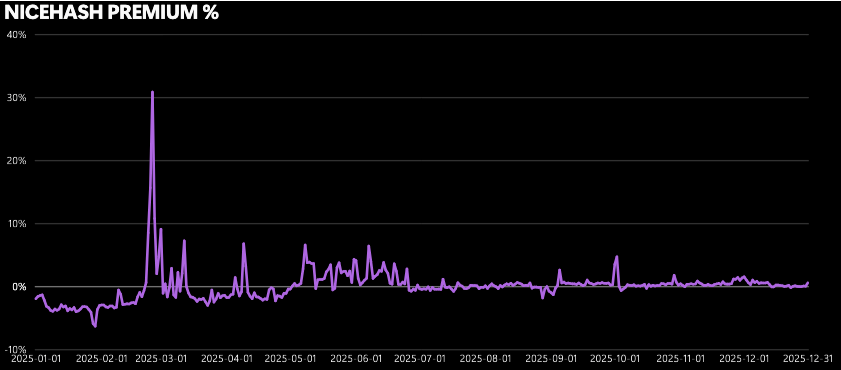
- Miners selling hashrate on NiceHash earned an average annual premium of 0.13% over the FPPS Hashvalue Index.
- During periods of high demand, this upside can be massive. The report highlights that on February 25th, 2025, RTPPS payouts on NiceHash exceeded the FPPS benchmark by a staggering 30.88%.
This data confirms that for miners seeking to maximize profitability, the open marketplace offers a "smart choice" for capturing value above standard market rates.
2. The Efficiency Wars: ASICs Enter the Sub-10 J/TH Era
2025 was a year of rapid hardware evolution. The industry saw the introduction of 40 new ASIC models, with manufacturers like Bitmain, MicroBT, and new entrants pushing the limits of efficiency.
- Efficiency Gains: The latest generation of machines has firmly established efficiency standards under 15 J/TH. Looking ahead to 2026, the report projects the arrival of "fourth-generation" miners targeting sub-10 J/TH efficiency. Notable examples include the announced Antminer S23 Hydro at 9.5 J/TH and Bitdeer’s upcoming SEALMINER series.
- Breaking Barriers: Hardware is also becoming more powerful. New units like the Antminer U3S23 Hyd have broken the 1 PH/s barrier in a single machine.
- Liquid Cooling: There is a clear industry trend toward hydro and immersion cooling. These technologies are becoming essential for industrial-scale operations to handle higher power densities and improve hardware longevity.
3. Hashrate Centralization & The "5% Era"
The Bitcoin network has entered the "Zetahash Age," crossing the 1 Zetahash-per-second (ZH/s) threshold in September 2025. However, this growth has come with increased centralization:
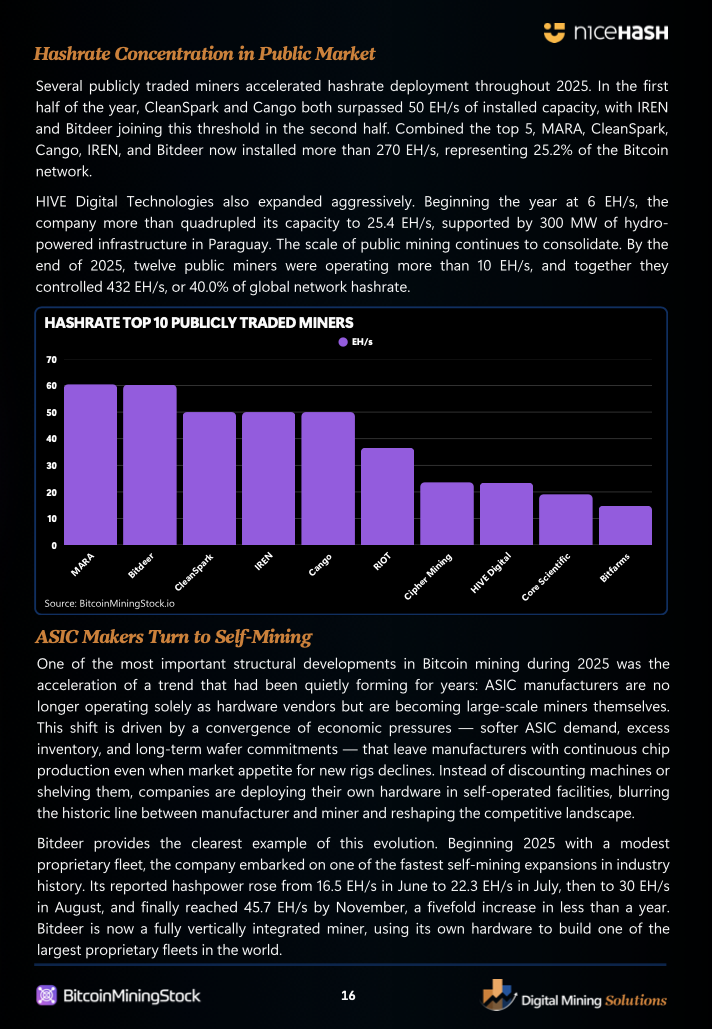
- Public Miner Dominance: Publicly traded mining companies now control roughly 40% of the global network hashrate. This scale allows them to negotiate better hardware pricing and access cheaper capital, widening the gap between mega-miners and smaller operators.
- The 5% Era: With over 95% of all Bitcoin now mined, we have entered the "5% Era," where the remaining supply will take over a century to extract. This engineered scarcity is driving mining to become a game of "operational excellence" rather than just rapid expansion.
- Manufacturer-Miners: A key trend is ASIC manufacturers like Bitdeer and Canaan becoming large-scale miners themselves, blurring the lines between hardware suppliers and operators.
4. The AI & HPC Pivot: A Structural Shift
Perhaps the most significant change in 2025 was the collision between Bitcoin mining and the booming Artificial Intelligence (AI) sector.
- Power is the New Gold: The report notes that "Power—not hardware—has become the primary limiting factor" for growth.
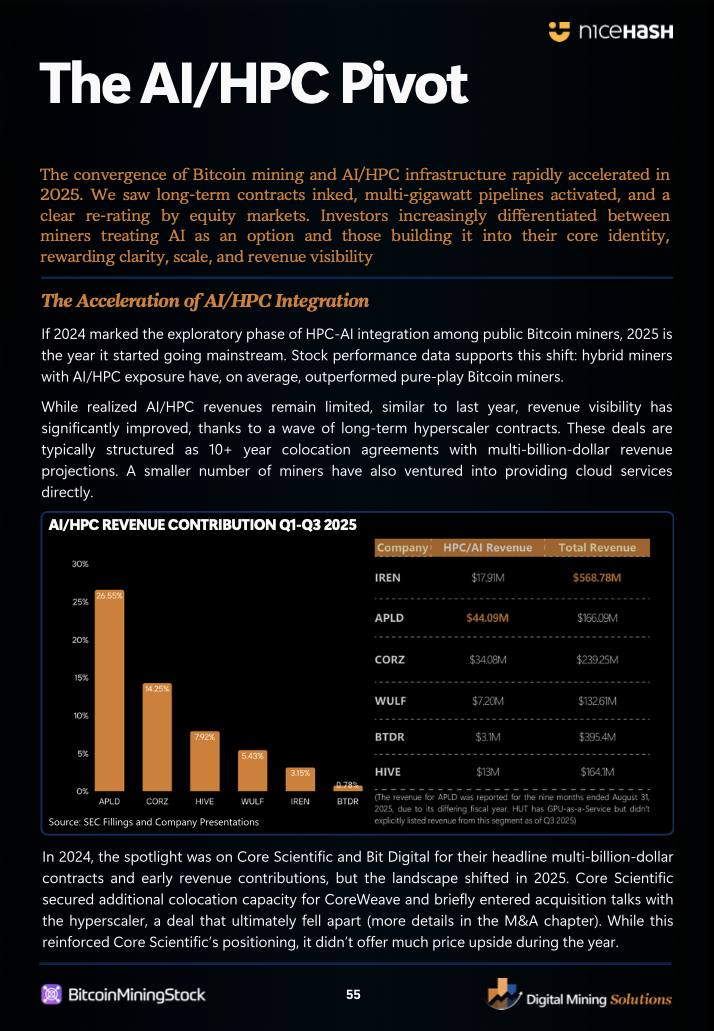
- Competing for Megawatts: Miners are no longer just competing with each other; they are competing with hyperscalers and AI firms for energy infrastructure. This has led many public miners, such as IREN and Core Scientific, to pivot toward High-Performance Computing (HPC) and AI hosting, where revenue per megawatt is structurally higher.
- Geographical Shifts: As AI data centers absorb premium power capacity, Bitcoin mining is increasingly being pushed toward flexible, grid-interactive models and "energy-adjacent sites" in regions with surplus power or stranded energy.