How to use NiceHash OCTune with QuickMiner? (Updated)
OCTune is a powerful browser-based mining overclocking tool that works with NiceHash QuickMiner.
Redesigned OCTune is only available on QuickMiner v0.5.4.4.0 RC and newer versions.
Before proceeding, we recommend that you read the blog post explaining OCTune, which gives you a basic overview of the OCTune layout.
This guide covers these topics:
- How do you open OCTune?
- How to use the classic overclocking method in OCTune?
- How to use the alternative overclocking method in OCTune?
- How to use Auto Tune in OCTune?
- How to use the Profiles tab in OCTune to modify optimization profiles?
#1 How do you open OCTune?
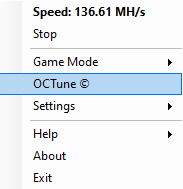
Once you have downloaded and installed NiceHash QuickMiner simply navigate to the taskbar and right-click on the NiceHash QuickMiner icon and then select OCTune, as shown in the image below.
#2 How to use the classic overclocking method in OCTune?
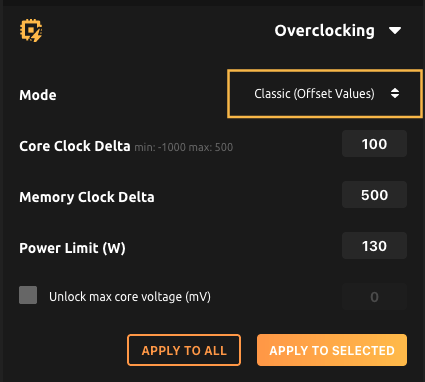
Use this method only with GTX 1060, 1070, and 1080 series GPUs. Users GPUs of Quadro, Tesla, Volta, GTX 1660, RTX 2000, and RTX 3000 series should use the "Alternative Mode".
Search the Excavator OC Tuner table for UMed KT. Your goal is to keep this value as low as possible.
- Select a GPU in the Excavator Status table.
- Use these settings as a starting point for your GPU overclock.
- Once the settings are applied, let it run for a few minutes. There should be no HW err in the Excavator OC Tuner table.
- Increase the "Memory clock delta" by +25 and let it run. Repeat until your mooring/rig freezes/crashes or you see an HW err in the Excavator- OC tuner table.
- Lower the " Memory clock delta" by -10 and check if the HW-err is still increasing. If so, lower it, by another -10 until the HW err stops rising.
- Most GPUs in the GTX 1000 series prefer a higher core clock. Try increasing it by +25 until you see the HW err increase or the driver crashes. Lower it by -10 , until the HW err stops rising and the system becomes stable.
- Lower the TDP by -5. The hashrate starts to drop, but the efficiency might be higher. Find your personal "sweet spot" by playing with the power limit.
- Click on the "Save" button to save the settings for this GPU.
- Repeat the process for the other GPUs, selecting them in the Excavator Status table.
NOTE: "The classic overclocking method" uses 3 variables, while the "Alternative overclocking" uses only 2 variables. This makes the "Alternative overclocking" easier. We recommend all users with GPUs of the series GTX 1660, RTX 2000, and RTX 3000 to use the "Alternative Overclocking". AMD users should only use Alternative OC method.
#3 How to use the alternative overclocking method in OCTune?

We strongly recommend using this method for all Volta, Quadro, Tesla, GTX 1660, RTX 2000, and RTX 3000 GPUs.
- Open Overclocking tab and change Mode to Alternative.
- Select a GPU in the Excavator Status table.
- First determine the "maximum memory clock" for the GPU by increasing the "memory clock (absolute)", until you get rejected shares (share above target or HW err in the "Excavator OC Tuner table). Lower the "memory clock", by -10, until you get no HW errors anymore.
- Start with a higher "Core clock Limit" (1500 for example), then lower the "Core clock Limit", by -15 u watch the Speed (MH/s), Power Real (W), and Eff. (kH/J).
- After each reduction of the "Core clock Limit", check the values Min KT, Avg KT, and UMed KT (UMed KT is the most important). These values should be as low as possible. The lower they are, the better the speed. When you are satisfied with the achieved speed. you can save your OC settings by pressing the "Save" button on the right-bottom part of the OCTune.
Note that if you change your "memory clock", you will need to readjust the "core clock limit" (maybe just +15 or -15).
#4 How to use Auto Tune in OCTune?
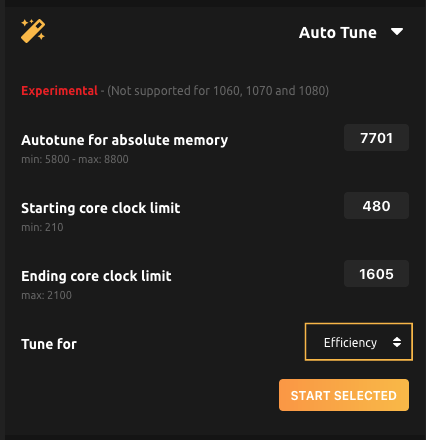
Auto tune uses the "Alternative Overclock Unbgs Method "and is only supported on Quadro, Tesla, GTX 1660, RTX 2000, and RTX 3000 GPUs.
- Follow the first step of the above alternate overclocking guide and determine your best absolute "memory clock" settings.
- Open Auto Tune on the right side.
- Select a GPU in the Excavator Status table.
- Copy the absolute "memory clock" from the "Alternative Method" to Auto tune (Auto Tune for absolute memory).
- Input optional "Starting Core clock Limit" and "Ending Core clock Limit".
- Select tune for "Efficiency" or "Speed".
- Select "Start", to start auto-tuning.
- Wait and watch the Events Log. When finished, make sure to apply the settings by pressing the Save button.
- Repeat the process for other GPU models if needed.
The result could be further tweaked to perhaps gain an extra 1% in performance or efficiency, but considering that Autotune does everything automatically and very quickly (only one iteration through workable core clock limits at a time to test performance), it raises the serious question of whether additional tweaking is worth your time.
#5 How to use the Profiles tab in OCTune?
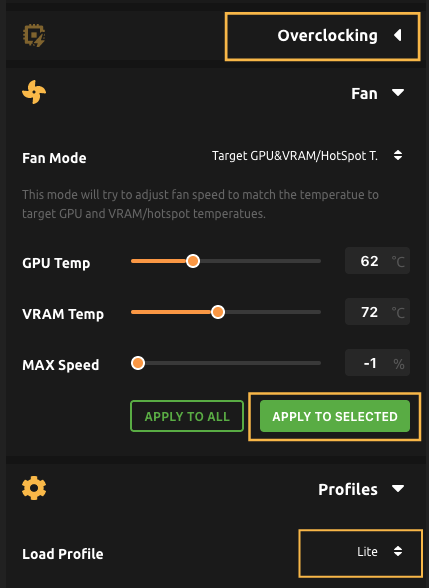
You can modify existing optimization profiles supported by QuickMiner within the Profiles tab in OCTune.
- Expand the Profiles tab on the far right side of OCTune.
- Select a GPU in the Excavator Status table.
- Select the desired profile you want to modify.
- Once the profile is selected, input fields in Overclocking and Fan tabs will be prefilled with data from the Optimization Profiles. Expand these two tabs.
- Edit the desired settings like fan temperatures or OC settings (make sure to check both Classic and Alternative overclocking modes)
- Click on the green button "Apply to selected"
If you have further questions, don't hesitate to join our Reddit- and Discord- community for help from other users and our company representatives.