Crypto Trends to Watch in 2023: Where the Industry Goes from Here
The crypto market charges forward in 2023 with full force.
While Bitcoin is up +40%, altcoins like Tezos (XTZ) and Aptos (APT) are boosted even more, at +60% and +400% respectively, based on their own anticipatory dynamics.
Regardless of whether this trend continues, it marks an important psychological shedding of the worst year in crypto.
Following 2022’s lessons and countless bankruptcies, whether crypto turns bullish will largely depend on the Federal Reserve’s monetary policy, macro-conditions, and the stock market’s reaction.
However, there are some crypto trends in 2023 that are more clear cut than others. Let’s dive into three of them.
Increased Regulatory Scrutiny
Whether for good or bad, the US legal landscape has largely been devoid of crypto regulations in terms of actual laws. Instead, regulatory agencies, such as the SEC and FinCEN, have issued a patchwork of regulations and guidance. This lack of comprehensive federal laws has led both crypto companies and individuals in a state of uncertainty.
Predominantly, the SEC has been left in charge of the legislative void. The commission has:
- Proposed amendments to existing SEC regulations in 2019 to allow companies to raise funds through ICOs (Initial Coin Offerings).
- Sued multiple individuals and companies for conducting illegal ICOs and defrauding investors.
- Began to review applications for Bitcoin ETFs (exchange-traded funds), without a single approval to date (the first was filed back in 2013 by the Winklevoss twins).
- Published guidelines in 2020 clarifying when a digital asset may be considered a security under US law.
The last point holds the most significant potential impact. The SEC used the “Howey Test” to determine if a cryptocurrency could be categorized as an investment contract - a security. If a digital asset was launched with the expectation of profits derived from the efforts of others, it very well could be in the eyes of the SEC.
This would likely apply to every single cryptocurrency except for Bitcoin and Litecoin, and possibly Ethereum, according to multiple SEC commissioners.
Left to its own regulatory devices, such a scenario has yet to be determined by a legal precedent in the SEC vs. Ripple Labs case. If the SEC wins, it would impact the way cryptocurrencies are bought and sold, as well as how companies in the industry operate.
The vast majority of crypto projects would then have to comply with securities laws and regulations:
- Registering their offerings with the SEC, which is both time-consuming and very costly.
- Limited trading, as securities are subject to more restrictions, which would limit the potential investor base for crypto projects.
- Ramped up compliance and legal costs to adhere to the new regulatory standard would likely cause a crypto exodus from the US.
In turn, these restrictions would increase investor protection while simultaneously cutting the air of innovation that the crypto space is known for.
Fast forward to early 2023, after a year of collapses, bankruptcies, and investors losing billions in the crypto space.
On the executive edict front, the White House issued a crypto roadmap on January 27th. The framing starts from a negative outlook, as “Roadmap to Mitigate Cryptocurrencies’ Risks”.
Citing Terra’s UST stablecoin implosion and the FTX crash, the Biden admin doesn’t view the crypto space favorably. Any potential legislative action by Congress should “not greenlight mainstream institutions, like pension funds, to dive headlong into cryptocurrency markets.”
To do so would be “a grave mistake”, according to the White House. The most likely scenario is that the Biden admin will favor legislation that in turn favors established financial institutions. Case in point, former Goldman Sachs employees and other associates played a big role in forming the Biden team in 2020.
By the same token, Goldman Sachs has unveiled plans to go on a multi-million crypto discount shopping spree following the FTX collapse, after already having invested in 11 crypto startups. And they are not alone in that outlook.
"Customers have lost trust in some of the younger businesses in the sector that purely do crypto, and are looking for more trusted counterparties."
-Mark Bruce, CEO of Britannia Financial Group to Reuters
Regardless, what’s clear is that the US Congress is full of representatives calling on new laws to protect investors. Regulatory agencies are generally reactive as opposed to proactive - and it’s likely that they’ll react to 2022 with incoming regulations in 2023.
Securities Tokenization
Bitcoin played a crucial role in establishing digital assets as a legitimate concept in the mainstream consciousness. Alongside this milestone task, Bitcoin also showcased the advantages of blockchain technology itself. Because blockchain enables records to be immutable, this opened the door to trusted 24/7 settlements without intermediaries.
The next evolutionary step is the tokenization of securities. As such, security tokens are digital representations of real-world assets: bonds, stocks, real estate or even artwork, if sold as an investment. Ownership of these assets is recorded on a blockchain ledger as a token, making it more secure, transferable, and accessible to a wider range of investors.
In this intersection between blockchain tech and traditionally regulated securities, we can look forward to a 24/7 marketplace for securities, drastically increasing liquidity and accessibility. At least, that is what Larry Fink foresees as the CEO of BackRock, the world’s largest asset manager with $10 trillion AuM:
“I believe the next generation for markets… for securities, will be tokenization of securities.”
-Larry Fink, CEO of BlackRock
Why is that important?
Following the GameStop/AMC short squeeze in January 2021, we have seen the underbelly of stock trading. It is a fragile labyrinth that consists of multiple intermediary institutions. In turn, when the trading volume is high, it can result in over 1 million GME shares failing-to-deliver (FTD).
That’s because the US stock market relies on a two-day trade settlement period (T+2), from the broker (e.g. Robinhood) to the market maker (e.g. Citadel Securities) and into the clearinghouse (DTCC). If tokenized, such trades would execute on a single, secure blockchain network in real-time, 24/7.
“There is no reason why the greatest financial system the world has ever seen cannot settle trades in real time. Doing so would greatly mitigate the risk that such processing poses.”
-Vlad Tenev, CEO of Robinhood
Consequently, with the settlement time near-instant on a blockchain, the risk is reduced. And as more trades can be executed in a shorter time frame, eliminating trade-settlement lag, this leads to better price discovery and increased market liquidity.
When CBDCs are deployed, we will likely see this kind of enhanced efficiency in the forex markets as well. Presently, because traditional banks serve as intermediaries, traditional forex brokers also deal with a multi-day trade-settlement lag.
More GameFi, NFTs and Options Trading
Coming full circle, why is it that Aptos (APT) is up by over +400% this year? Outside of the fundamentals of being a novel and fast proof-of-stake L1 chain, much of that has been driven by NFT trading. In turn, this increased the overall speculation buzz and APT demand.
As Mohammad Shaikh, co-founder of Aptos Labs explains, non-fungible tokens (NFTs) should go beyond mere collectibles in 2023:
“NFTs should have an opportunity to live in things like games, social platforms that might be out there, where you share what you own, why you own it and really connect with the community.”
In other words, just like tokenized securities bridge traditional finance and blockchain, NFTs provide agnostic ownership tokenization. This extends from GameFi to even car titles as NFTs, which is presently being implemented by California DMV on a privately instanced Tezos blockchain.
On one end, GameFi is a subset of the metaverse, as people use portable digital assets to engage in gamified financial tools, like yield farming, borrowing and lending. But zoomed out, metaverse revolves around portable digital assets used across multiple virtual environments in a seamless manner.
It’s this blockchain interoperability that creates the “meta”. In 2023, we will see multiple Web3 gaming ecosystems come online, including the newly launched MetaPixel for Aptos, from the renowned Korean NPIXEL, the creators of Gran Saga that is soon coming as Gran Saga Unlimited on Aptos.
2022 may have been overflowing with bankruptcies, but it bears keeping in mind that the ‘metaverse’ received $120 billion in just the first half of the year, according to a McKinsey report.
Even JPMorgan published hyper-bullish metaverse forecasts:
“The metaverse will likely infiltrate every sector in some way in the coming years, with the market opportunity estimated at over $1 trillion in yearly revenues.”
In 2023 and the following year, these investment seeds are bound to sprout into metaverse trees. However, we have yet to see a ‘killer’ app or game. Until that happens, institutional traders will increasingly use crypto options trading to hedge their bets.
Increased Crypto Options Trading
During the bear market in August, speculation on Ethereum's Merge was all the rage, even outpacing Bitcoin open interest. However, given how young the crypto industry is, Bitcoin’s slight 2% open interest was impressive compared to traditional options on stocks at 20% of S&P 500’s market cap.
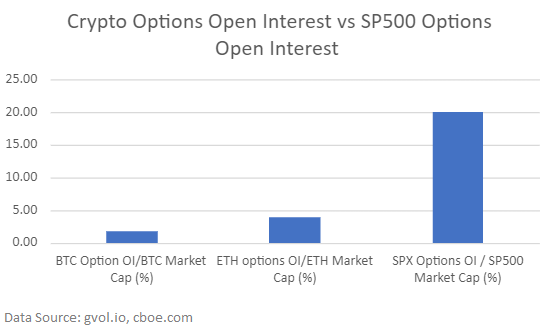
At the time, Enhanced Digital Group (EDG) forecasted this as the beginning of growth and popularity in crypto options trading.
“When you think of all the other [S&P 500]-like products including ETFs, SP Minis, etc., you can see that bitcoin options have multifold growth ahead of it,”
-EDG’s Marcin Maksymiuk
In 2020, amid Covid-19 shutdowns, options trading became incredibly popular among a younger, retail-oriented audience. This trend continued into 2021, which saw a 35% increase YoY in options trading, fueled by retail. From easy to use trading apps such as Robinhood and the popularity of options alerts to help guide newer investors, popularity in options trading skyrocketed among a newer, younger demographic - the same demographic that actively trades cryptocurrencies as well.
Options trading has slowed down since then - as all markets have - but interest in crypto options is starting to return.
Nearing the end of January, time has proven Marcin correct. Open interest on CME Bitcoin futures rose to a near-record high of 21%, according to Arcane Research. As before, more institutional investors jumped in betting on Bitcoin price moves.
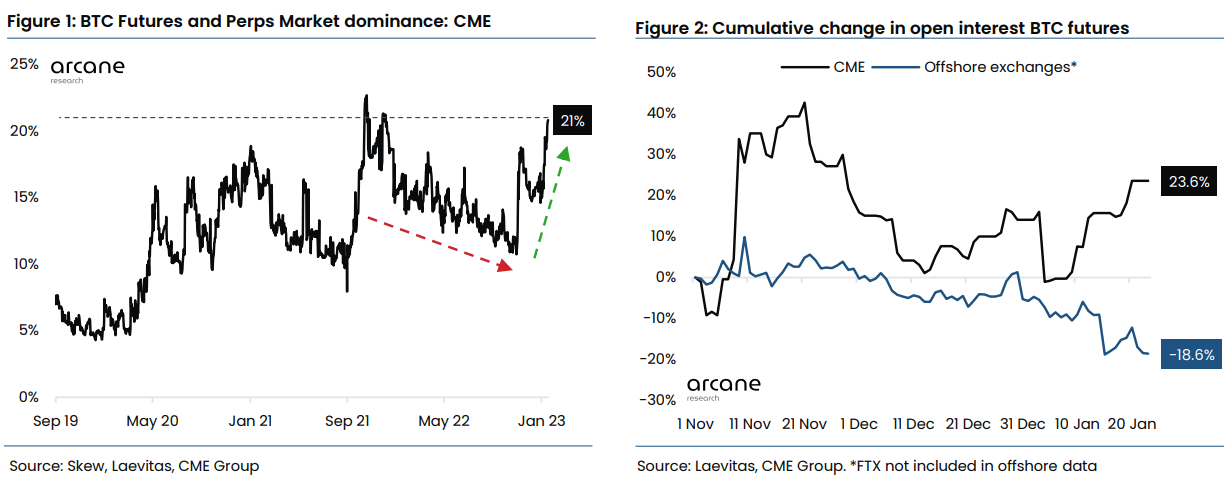
With the likelihood of Bitcoin being deemed as the only top commodity, amid an ocean of crypto securities, we could very well see this reflected further in the crypto derivatives market.