Les Mineurs de Bitcoin Se Tournent-ils Vers l’IA ?
Chaque grande société de minage cotée en bourse présente aujourd’hui la même diapositive dans ses présentations aux investisseurs. Une image d’un cluster de GPU, les mots « HPC » et « IA » bien visibles, ainsi qu’un graphique de revenus projetés qui s’envole vers le haut. Cela paraît impressionnant. Cela soutient le cours de l’action. Mais, dans une large mesure, cela reste déconnecté de la réalité physique sur laquelle repose la majorité du hashrate mondial.
Ce qu’une transition vers l’IA exige réellement : une alimentation électrique stable et redondante avec un taux de disponibilité proche de 100 %, un système de refroidissement de niveau datacenter et plusieurs mois de travaux pour déployer l’infrastructure nécessaire. On ne peut pas simplement débrancher une rangée d’ASICs et remplacer les machines par des H100 dans un conteneur alimenté par du gaz torché.
« On ne peut pas simplement débrancher une rangée d’ASICs et remplacer les machines par des H100 dans un conteneur alimenté par du gaz torché. »
Où se trouve réellement le hashrate
Une part considérable du hashrate mondial fonctionne sur des infrastructures structurellement incompatibles avec les charges de travail IA et HPC. Des sites de réponse à la demande qui acceptent des contrats d’effacement avec les opérateurs de réseau. Des installations de récupération de chaleur où la chaleur produite par les ASICs constitue un avantage plutôt qu’un problème. Des champs pétroliers et gaziers où le méthane perdu est converti en électricité au lieu d’être brûlé à la torchère. Il ne s’agit pas d’opérations marginales. Elles représentent une part importante et croissante du hashrate mondial, et le minage de Bitcoin est souvent la principale raison économique qui justifie leur existence.
Aucun de ces sites ne deviendra un datacenter IA. L’alimentation électrique est trop intermittente, les infrastructures trop éloignées et les exigences de redondance beaucoup trop élevées. Le récit autour de l’IA est réel pour certains opérateurs et certaines installations. Mais il ne correspond tout simplement pas à la majorité du hashrate actuellement déployé.
Ce qui arrive réellement au hashrate du réseau
Le hashrate du réseau est passé d’environ 1 100 EH/s il y a six mois à près de 960 EH/s aujourd’hui, soit une baisse de plus de 10 %. La croissance restante est principalement soutenue par les fabricants d’ASICs qui déploient leurs propres réserves de matériel, comblant temporairement le vide laissé sur le marché, ainsi que par les petits mineurs hors réseau et les participants aux programmes de réponse à la demande.
L’avenir à long terme repose sur un modèle de symbiose énergétique : le minage comme activité secondaire permettant de valoriser une énergie autrement perdue ou limitée. Réponse à la demande, gaz de décharge, récupération de chaleur industrielle, géothermie. Ce sont les environnements où le minage de Bitcoin prospère, car l’alternative consiste simplement à gaspiller cette énergie.
Les grands mineurs n’arrêtent pas de miner
Les grandes sociétés minières cotées qui annoncent des projets HPC diversifient leurs activités sur des sites stables et bien connectés. Mais leurs autres infrastructures — installations soumises à l’effacement, opérations hors réseau et projets exploitant de l’énergie perdue — continueront à faire fonctionner des ASICs, car ces sites n’ont souvent aucune autre utilisation économiquement viable. La transition vers l’IA modifie l’allocation du nouveau capital. Elle n’entraîne pas l’arrêt de tout le matériel de minage existant.
Des marges serrées. Chaque décimale compte.
Si vous exploitez ce type d’installation aujourd’hui, les marges laissent très peu de place à l’erreur. Dans cet environnement, le choix du pool vers lequel vous dirigez votre hashrate devient une décision opérationnelle ayant un impact direct sur votre compte de résultat.
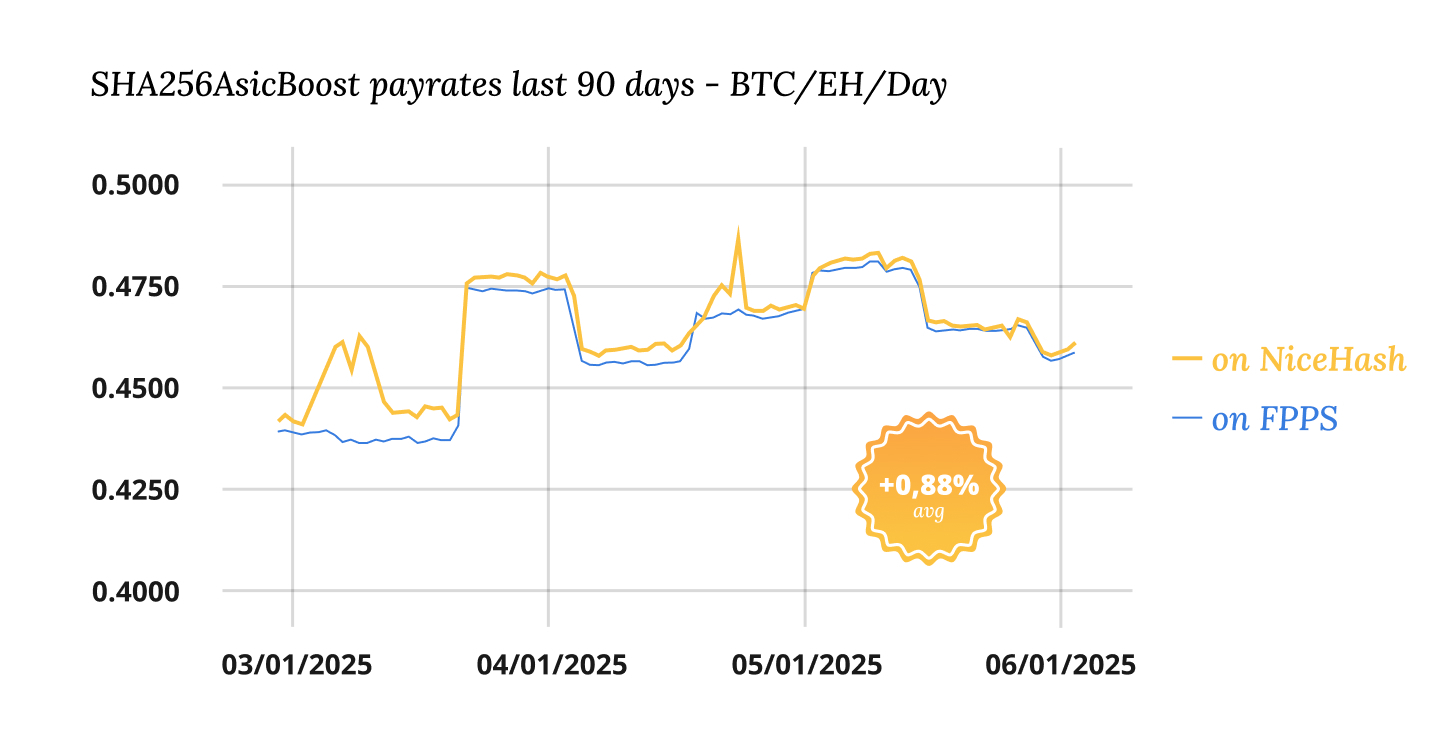
Les payrates NiceHash ont été en moyenne supérieurs d’environ 0,88 % à l’indice FPPS standard au cours des 90 derniers jours. Pour une exploitation à grande échelle, ce n’est pas un détail négligeable. Cela peut représenter la différence entre un trimestre rentable et une machine qui finit par être arrêtée. En plus d’offrir des rémunérations plus élevées en BTC, NiceHash propose également des revenus de hashrate libellés en USDT, permettant de couvrir directement les coûts d’électricité en stablecoins sans avoir à vendre vos réserves de Bitcoin.
Aucun processus complexe. Connectez et minez.
L’expérience utilisateur est identique à celle d’un pool de minage classique. Mettez simplement à jour votre adresse Stratum, utilisez ASIC Manager pour configurer votre flotte à grande échelle, et vos mineurs continueront à soumettre leurs shares normalement. Aucun nouveau workflow, aucune nouvelle logique comptable, aucune charge opérationnelle supplémentaire. Quelques heures de configuration suffisent pour bénéficier durablement d’un meilleur payrate.